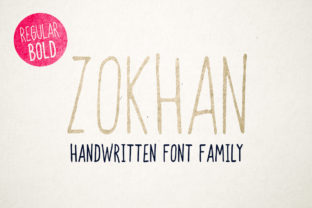
Zokhan: A Handwritten Font That Feels Like a Real Signature
It was 10:47 a.m., coffee lukewarm, and I’d just opened a blank brand board for a new client—a small-batch ceramic studio run by two artists who throw every piece by hand. Their work is tactile, imperfect, warm. The brief asked for “something that doesn’t look like it came from a template.” So I dropped in Zokhan, typed “River Clay Studio,” and paused. Not because it looked flashy—but because it looked known. Like someone had written it slowly, with care, on a notecard left beside a kiln.
A Script That Breathes—Not Just Swirls
Zokhan is a handwritten typeface, yes—but it’s not the kind that leans hard into flourishes or forced elegance. It’s relaxed. The lowercase ‘a’ has a soft, open bowl; the ‘g’ loops gently without overcomplicating itself; the ‘t’ ends in a subtle, unforced crossbar. There are no aggressive swashes or dramatic ligatures—just natural entry and exit strokes that mimic ink meeting paper. It’s part of the Script Amp collection, which means it’s built for impact without sacrificing authenticity. You get one weight (regular), but it includes smart alternates and contextual ligatures that activate automatically in OpenType-savvy apps like Illustrator or Figma. No extra setup—just type, and the rhythm shifts slightly where it feels right.
Where Zokhan Actually Works (and Where It Doesn’t)
I tested Zokhan across six real touchpoints:
- Logo draft: Paired with a quiet sans serif (we used Inter Light) for the tagline, it gave the logo presence without shouting. On a matte black business card, the contrast felt intentional—not trendy, just human.
- Packaging mockup: Printed at 14pt on kraft paper labels, it held up beautifully. The slight variation in stroke weight kept it legible even when scaled down—not something all handwritten fonts manage.
- Website hero section: At 48px on a clean white background, it read instantly. But I wouldn’t go smaller than 32px for headlines—anything under that starts to lose its warmth in web rendering.
- Social media graphics: On Instagram posts, it stood out in feeds full of rigid geometric fonts. Used sparingly—for quotes or limited-edition announcements—it created visual breathing room.
- Editorial layout: Not for body text, obviously. But as pull-quotes in a studio newsletter? Perfect. It added voice without competing with the main serif type (we used Lora).
- Shop sign mockup: At 3ft tall on a hand-painted wood panel, it translated cleanly—no blurring, no awkward gaps between letters. The spacing is generous but not loose, so it scales well.
Zokhan isn’t built for legal disclaimers, data tables, or corporate annual reports. It’s not a workhorse font—and it shouldn’t be. Its strength is in moments where you want to signal craft, care, or continuity with tradition. If your project needs neutrality, speed, or dense information delivery, reach for something else first.
Smart Pairing—Not Just Pretty Contrast
Because Zokhan carries so much personality, pairing matters more than usual. I found it sang alongside:
- A warm, low-contrast serif (like Cormorant Garamond or Literata) for editorial balance—serif handles structure, Zokhan handles soul.
- A neutral, humanist sans (Inter, Poppins, or even the free version of Manrope) for modern clarity in supporting text.
- Another script? Only if it’s dramatically different in rhythm or weight—say, a tight, upright brush script for subheadings. Two similar handwritten fonts cancel each other out.
What didn’t work: pairing it with high-contrast Didones (think Bodoni) or ultra-geometric sans serifs (like Futura). The contrast felt jarring, not intentional—like wearing linen with patent leather.
Practical Notes Before You Commit
Zokhan ships as desktop OTF files and includes webfont versions (WOFF2), so it’s ready for live sites—but always test loading performance, especially if you’re adding it alongside multiple custom fonts. It supports Latin-based languages (English, Spanish, French, German, etc.) but doesn’t include extended Cyrillic or Vietnamese diacritics. If your brand serves multilingual audiences beyond Western Europe, double-check coverage.
And this is non-negotiable: review the commercial license. Zokhan is a premium font, and while personal use is often covered, client work—especially packaging, merchandise, or SaaS interfaces—requires explicit permission. Some licenses restrict use in templates sold on marketplaces (like Creative Market or Etsy), so verify before building a Canva template or Shopify theme around it.
One last note: don’t skip the test phase. Drop Zokhan into your actual layout—not just a font sampler. Try it at the size it’ll appear on a product label. Print it. View it on mobile. See how it holds up next to photography or texture overlays. Fonts live in context, not isolation—and Zokhan’s charm is deeply contextual. It’s not “versatile” in the Swiss sense. It’s specific. And that specificity is exactly why it works so well when it’s the right fit.