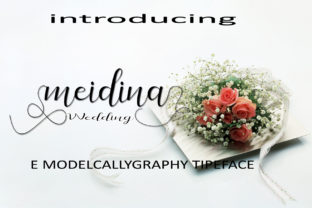
Meidina: A Handwritten Script Font That Feels Like Real Ink
I opened a fresh brand board last Tuesday—no moodboard yet, just a blank artboard and a quiet café client who said, “I want it to feel warm, human, and handmade—but not childish.” My first instinct? Skip the overused brush scripts and go straight to Meidina. Not because it’s trendy, but because it moves like someone actually wrote it—not traced, not digitized into stiffness, but drawn with intention and breath.
Meidina is a handwritten script font from Madyen Studio, part of their thoughtful Script Amp collection. It’s not flashy or exaggerated—it’s graceful, slightly tapered, with soft entry and exit strokes that taper like ink drying on paper. There’s subtle variation in stroke weight, gentle swashes on select capitals, and a relaxed rhythm that avoids mechanical repetition. It doesn’t shout. It leans in.
We started simple: testing Meidina in the logo lockup for the café’s name on a mockup of their front window decal. No background, no effects—just white vinyl on matte glass. Instantly, it felt grounded. Not too delicate (so it held up at 24 inches tall), not too dense (so it breathed between letters). The lowercase ‘a’ and ‘g’ have that quiet charm of a well-practiced hand—recognizable, consistent, but never robotic. And yes—it scaled beautifully down to business card size without losing its character.
In practice, Meidina works best as a display font: for logos, signage, product labels, social media headers, and short-form editorial accents. It’s not built for long paragraphs—no one wants to read a full menu or website body in a script this expressive. But as a headline? A shop sign? A ceramic mug label? Absolutely. It adds warmth without sacrificing clarity. On matte paper stock, it looks like letterpress. On a clean white Instagram post, it feels intentional—not decorative filler.
We paired Meidina with a warm, low-contrast serif—something with open counters and generous x-height—for all supporting text: menus, packaging copy, website body, and printed takeout bags. Think something like IBM Plex Serif or Domaine Display. The contrast worked because Meidina brings personality; the serif brings stability. No competing energy—just balance. We avoided pairing it with other scripts or overly geometric sans serifs, which made Meidina feel either lost or awkwardly out of place.
One thing I appreciated early on: Meidina includes thoughtful alternates and ligatures—not dozens, but just enough. A few elegant capital swashes, a couple of connected ‘f’ + ‘i’ or ‘t’ + ‘h’ options, and two versions of the lowercase ‘y’. Nothing overwhelming. Just real utility for refining spacing and rhythm when typesetting headlines or monograms. We used the alternate ‘S’ in the café’s monogram—it tilted just enough to echo the curve of their logo’s steam swirl.
No weights—just one carefully crafted style. That’s fine. It’s meant to be a voice, not a system. For hierarchy, we relied on size, spacing, and contrast with the supporting typeface instead of bold/regular toggles. And it worked: large Meidina on the storefront, medium on ceramic coasters, small-but-crisp on tea box labels—all legible, all cohesive.
Licensing was straightforward: commercial use included, no hidden restrictions. It came in OTF and WOFF2, so we dropped it into their Shopify site header without fuss—and it rendered cleanly across devices. No weird clipping on iOS Safari, no fuzzy edges on Android Chrome. Bonus: multilingual support covers Western European languages comfortably, which mattered for their seasonal specials (“Crème Brûlée” and “Pain au Chocolat” needed proper accents).
We tested readability in real-world conditions—not just on screen, but on physical mockups. Printed on kraft paper bags? Soft but clear. Laser-etched onto wooden spoons? Surprisingly crisp at 14pt. Embroidered on aprons? Too fine for thread—but that’s expected. Meidina isn’t meant for embroidery or laser-cut signage under 10mm. Knowing those limits saved us time and revisions.
For packaging, we used Meidina only where it added meaning: the product name on honey jars, the “small batch” tagline on oat milk cartons, the date stamp on weekly pastry boxes. Everywhere else—ingredients, sourcing notes, legal text—we stayed with the serif. Consistency wasn’t about repeating the same font everywhere. It was about using Meidina only where its humanity elevated the message.
On social, it shined in static posts—not carousels or reels, but single-image announcements: “New Lavender Shortbread,” “Open Late Thursdays,” “First Saturday of Every Month: Live Jazz.” Paired with warm, natural photography and generous whitespace, Meidina gave each post a quiet confidence. No filters needed. No extra styling. Just honest typography doing quiet work.
Would I use Meidina for a tech startup or a law firm? Probably not. Its strength is in craft-based, tactile, human-centered brands—skincare lines with botanical ingredients, independent bookshops, ceramic studios, slow-fashion labels, neighborhood bakeries. It’s for clients who care how things *feel*, not just how they look.
If you’re considering Meidina for your next project, test it early—not just in Figma or Illustrator, but in context. Drop it onto a real product mockup. Print it at actual size. Ask yourself: does it still feel intentional when it’s tiny? Does it hold up when it’s huge? Does it complement—not compete with—the imagery and tone around it?
And always check the file package before committing: confirm it includes the alternates you’ll need, verify the language coverage matches your audience, and scan the license for any usage notes (especially if you’re building templates for resale or SaaS platforms). Meidina is a premium font—not in price, but in craft—and it rewards thoughtful application.
At the end of the day, Meidina doesn’t try to be everything. It’s a focused, expressive tool—one that reminds us that great typography doesn’t have to shout to be heard. Sometimes, the most confident voice is the one that writes gently, clearly, and with unmistakable presence.