Dialoegue: A Fluid Handwritten Font That Feels Like a Real Conversation
It was 10:42 a.m., coffee still warm, and I’d just opened a fresh brand board for a local ceramicist’s rebrand—no brief yet, just mood boards, a few product shots, and that familiar blank canvas. I scrolled through my script font folder, paused at Dialoegue, and dropped it into the logo draft on instinct. Not because it was trendy, but because the client had said, “I want people to feel like they’re holding something made by hand—not printed, not polished, but *present*.” And just like that, Dialoegue clicked.
What It Actually Looks Like in Practice
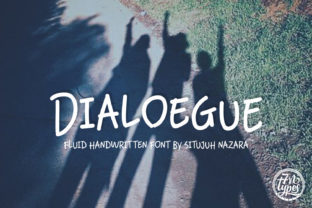
Dialoegue is a fluid handwritten font designed by Situjuh Nazara—and “fluid” isn’t just marketing speak. The letters connect with gentle, organic momentum. There’s no forced calligraphy tension or exaggerated swash; instead, rounded terminals, consistent stroke weight, and subtle entry/exit flourishes give it rhythm without fuss. It’s bold enough to hold its own at 36pt on a café chalkboard or 24pt on a business card—but never overwhelming. What surprised me most? How legible it stayed even when scaled down to 14pt on a product label mockup. Not *body text* legible—but perfectly clear for short phrases, ingredient lists, or shop signage where warmth matters more than density.
Where It Shines (and Where It Steps Back)
I tested Dialoegue across six real touchpoints: logo lockup, brand board typography hierarchy, matte-finish ceramic packaging labels, Instagram story banners, a simple one-page website header, and letterpress-style business cards. In every case, it performed as a confident *display font*—not a workhorse, but a voice. On packaging, it softened the minimalism of clean sans-serif body copy without slipping into cutesy. On the website hero section, paired with a warm neutral serif (I used IBM Plex Serif), it created instant visual contrast and emotional grounding. Social media graphics felt personal, not generic—like a note slipped under your door rather than a broadcast.
That said, Dialoegue isn’t built for long paragraphs, legal disclaimers, or corporate annual reports. Its charm lives in brevity: names, taglines, quotes, shop names, product titles. I tried it on a flyer with three dense bullet points—and immediately swapped it out. It’s a script font with purpose, not decoration. As part of Script Amp’s curated collection, it sits comfortably alongside other expressive, high-quality fonts—but stands apart for its balance of playfulness and polish.
Pairing It Without Overthinking
You don’t need a font pairing guide to make Dialoegue sing—but you do need intention. I found it pairs best with typefaces that offer quiet structure: a relaxed serif like Sorts Mill Goudy or Libre Baskerville for editorial warmth, or a grounded sans like Inter or Manrope for modern clarity. Avoid competing scripts—two handwritten fonts create visual noise, not harmony. And while Dialoegue has no built-in alternates, ligatures, or swashes (it’s refreshingly focused), its single-weight design means consistency is baked in. No need to hunt for the “right” version—it’s all there, clean and ready.
A Few Practical Notes Before You Commit
First: licensing. Dialoegue is a commercial font—you’ll need an appropriate license for client work, especially if it appears on physical packaging, merchandise, or web assets served to users. Check whether your license covers webfont embedding (some require separate web licenses) and verify multilingual support if your project includes diacritics or extended Latin characters. File formats are standard (.otf, .woff2), and installation is seamless across Mac and Windows design apps.
Second: test early, test small. Drop Dialoegue into your actual layout—not just a font menu preview. Try it on a printed business card proof, zoom in on a mobile screen mockup, and read it aloud. Does “Hand-poured • Small-batch • Made in Portland” feel inviting or fussy? That gut check matters more than any spec sheet.
Third: know when to stop. Dialoegue thrives as a singular accent—not the whole system. Use it for the brand name, then step back. Let your supporting typeface carry the rest. That restraint is what makes it feel intentional, not indulgent.
Final Thought—Not a Conclusion, Just a Note
Fonts like Dialoegue don’t solve branding problems. They reflect decisions already made—about voice, audience, craft, and care. It won’t make a weak concept strong, but it *will* make a thoughtful one feel unmistakably human. If your project values authenticity over authority, warmth over width, and presence over perfection—Dialoegue is worth opening that blank board for.