Donkiciro: A Hand-Painted Brush Font That Feels Like Real Ink
I opened a blank brand board last Tuesday for a local ceramicist’s rebrand—no mood board yet, just white space and the quiet hum of my laptop fan. She’d asked for something warm, tactile, and quietly confident—not “cute,” not “vintage,” but human. I scrolled past three script fonts that felt too polished, two that leaned too hard into calligraphy tropes, and then paused on Donkiciro.
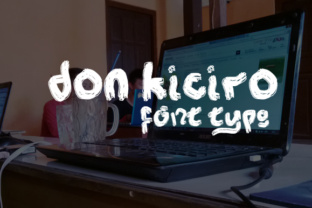
It’s exactly what it says it is: a hand-painted brush font. Not digitized calligraphy. Not a vector trace of ink. It’s built from actual brush strokes—slight wobbles, subtle tapering, uneven pressure, even faint texture where the bristles catch and release. You can see the rhythm in the lowercase g, feel the lift in the exit stroke of the t, sense the pause before the loop in the y. This isn’t about perfection. It’s about presence.
Where Donkiciro Lives—and Where It Doesn’t
In logo design? Absolutely—especially for brands rooted in craft, care, or calm energy. I tested Donkiciro on her studio name in a vertical lockup on a matte ceramic mug mockup. It held up beautifully: the slight irregularity echoed the glaze variations on her pieces, and the weight of the strokes gave it physicality without shouting. On a business card printed on soft-touch paper? Even better—the font’s organic edges softened further against the texture, making it feel like part of the object, not slapped on top.
For packaging labels—think small-batch herbal tea tins or handmade soap bars—it works best at 14–24pt as a primary name or subheading. Below 12pt, legibility dips slightly, especially in the tighter letterforms (s, e, a). That’s not a flaw; it’s a cue. Donkiciro isn’t meant for ingredient lists or regulatory text. It’s a display font, full stop—a headline font, a logo font, an accent font for moments that deserve attention and breath.
I tried it in a website hero section with light gray body copy (set in a clean, neutral sans serif). The contrast worked because Donkiciro didn’t compete—it anchored. It said, “This is who we are,” while the supporting type handled the “what” and “how.” Same on Instagram: a single-line quote over a muted photo landed with more sincerity than any sleek sans-serif ever has.
What’s Inside the Files—and What to Check Before You Commit
Donkiciro comes as a single weight—intentionally. No light, no bold, no italic. Just one expressive, fully realized brush style. It includes standard OpenType features: discretionary ligatures (like fl, tt, st), contextual alternates that subtly shift letterforms based on neighbors, and a handful of elegant swashes for the capital letters. These aren’t gimmicks—they’re refinements that help the rhythm flow when setting longer words or short phrases.
No multilingual support beyond basic Latin (including accented characters for French, Spanish, German). No Cyrillic or Greek. If your project serves a broader linguistic audience, test those characters early—or pair Donkiciro with a robust, compatible sans serif for body text where needed.
Files are delivered as .OTF and .TTF, webfont-ready via WOFF2. But here’s the practical note every designer should pause on: check the license. Donkiciro is sold through Script Amp, and their commercial license covers client work, packaging, merchandise, and digital products—but always verify scope before handing files to a printer or embedding in a Shopify theme. Fonts like this live or die by proper usage rights, especially when applied to physical goods.
Pairing It Without Overthinking
Donkiciro doesn’t beg for complexity. In fact, its strength lies in contrast. I paired it consistently with Public Sans (a free, highly legible sans serif) across the ceramicist’s brand board—and it clicked instantly. The warmth of the brushwork balanced by the quiet authority of the sans. For editorial layouts or product catalogs, a gentle serif like Freight Text or Adobe Garamond also holds its own, offering structure without stiffness.
Avoid pairing it with other scripts—especially ones with similar energy. Two handwritten fonts in one composition rarely settle into harmony; they tend to argue. And skip ultra-thin or geometric sans serifs unless you’re aiming for deliberate tension (e.g., a modern art gallery identity where contrast is the point). With Donkiciro, simplicity is strategic.
When to Step Back
Donkiciro shines in environments where authenticity reads louder than polish: artisanal food brands, independent bookshops, wellness studios, handmade goods, creative workshops. It falters—predictably—in contexts demanding neutrality, speed, or scalability across dense interfaces. Think corporate annual reports, SaaS dashboards, legal disclaimers, or multilingual e-commerce filters. It’s also not ideal for long-form web copy or mobile navigation menus. Its charm is concentrated, not expansive.
And one real-world observation: on high-gloss packaging or backlit digital signage, some of the subtler texture can get lost. I tested it on a laminated café menu board—fine at arm’s length, but the delicate entry/exit strokes blurred slightly under bright overheads. When in doubt, print a 3-inch sample at actual size and hold it at viewing distance.
If you’re weighing Donkiciro for a branding project, treat it like a collaborator—not a plugin. Try it on the thing that matters most first: the logo lockup, the product label, the homepage headline. See how it behaves in context, not isolation. Does it deepen the story, or distract from it? Does it feel like it belongs—or like it’s visiting?
For the ceramicist? It did belong. Her new logo sits centered on her kiln-fired business cards, inked with intentional imperfection. Clients comment on how “real” it feels. Not because it’s trendy—but because it’s made by hand, and used with intention.