Rositha: A Hand-Painted Script Font That Feels Like Real Ink
It was a Tuesday morning, rain tapping lightly against the studio window, and I’d just opened a fresh brand board for a new client—a small ceramic studio in Portland that makes minimalist mugs, bowls, and tableware by hand. Their voice is quiet but intentional: warm, grounded, thoughtful. No loud slogans. No flashy gradients. Just honesty, texture, and care. So when I reached for a script font to test on their logo lockup, I scrolled past the usual suspects—too ornate, too digital, too “designed.” Then I saw Rositha.
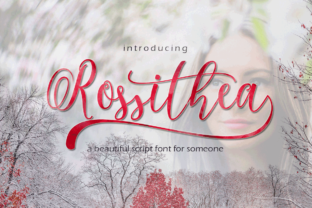
Rositha is a hand-painted script font by Meutuwah, part of the Script Amp collection—and right away, it felt different. Not because it’s overly decorative or complex, but because it breathes. Each letter has subtle ink bleed, slight variation in stroke weight, and gentle, organic flow—like someone sat down with a fine brush and painted it slowly, without tracing or smoothing. It’s not perfectly symmetrical. It doesn’t try to be. And that’s exactly why it worked so well for this project.
I dropped Rositha into the logo mockup first as a wordmark: just the studio’s name, centered, set at 48pt on a soft oat-colored background. Instantly, it added warmth without sacrificing clarity. The lowercase “a” has a delicate upward flick; the “g” curls with quiet confidence; the “t” ends in a tapered, almost imperceptible lift. It’s legible at a glance—but lingers longer on the eye. That balance—personality *and* precision—is rare in script fonts, especially hand-painted ones.
In practice, Rositha shines brightest as a display font: ideal for logos, shop signage, product labels, Instagram story headers, and limited-run packaging. I used it on a matte sticker label for their mug boxes—paired with a clean, light-weight sans serif (Inter Light) for ingredients and care instructions. The contrast felt natural, not forced: Rositha carried the soul; the sans serif handled the facts. No hierarchy confusion. No visual shouting.
What surprised me most was how well it held up across formats. On screen, in a website hero section, Rositha retained its tactility—even as a web font (WOFF2, included in the download). In print, on uncoated paper stock, the subtle texture translated beautifully: no pixelation, no flattening of character nuance. And on a small business card? Still readable. Still expressive. Still unmistakably *human*.
Rositha isn’t built for body text—and it shouldn’t be. It’s not a workhorse typeface. It’s a storyteller. Think of it as the handwritten note tucked inside a gift box, not the instruction manual stapled to the side. For longer copy—website paragraphs, email newsletters, product descriptions—I paired it with a relaxed serif (Cormorant Garamond Regular) and a neutral sans (Manrope). The trio felt cohesive: Rositha for voice, serif for warmth and rhythm, sans for utility. All three share an underlying respect for space and proportion—no clashing energy.
The font includes one weight (Regular), with full Latin character support, standard ligatures, and a thoughtful set of alternates—including a swash “Q”, a looping “y”, and two versions of the ampersand. These aren’t gimmicks. They’re practical tools. I swapped in the alternate “y” on a poster headline where the baseline needed extra motion—and it subtly lifted the whole line. The ligatures activated automatically in Illustrator and Figma, cleaning up common letter collisions (like “fi”, “fl”, “tt”) without manual tweaking.
Licensing is straightforward: commercial use is fully covered, including merchandise, social assets, and client deliverables. No hidden tiers or usage caps. That matters—especially when handing off final files to a small business owner who’ll print business cards, order stickers, and update their Instagram bio themselves. You don’t want to explain font licensing over coffee. Rositha avoids that friction.
One thing I always do before locking in any script font for a full identity system? I test it in three real-world contexts:
- A tiny application (like a 12mm-diameter ceramic stamp)
- A medium-scale use (like a 16oz reusable tote bag)
- A large-format surface (like a 36" wide shop banner)
That said, Rositha does ask for thoughtful placement. It’s not a “drop-in-and-go” font for every headline. It needs breathing room. Tight tracking or heavy kerning can mute its natural rhythm. I found optimal spacing by loosening letterspacing slightly (+20–30 units in design apps) and letting the forms speak for themselves. Also worth noting: while it’s deeply expressive, it’s not overly casual. It won’t suit a skate brand or a punk record label—but for makers, studios, wellness spaces, botanical brands, or local eateries with slow-food values? It lands with sincerity.
For designers building identities where authenticity matters more than polish, Rositha is a quiet upgrade. It doesn’t shout “look at me”—it invites you closer. That makes it powerful in crowded digital feeds and increasingly homogenized retail environments. When your client’s mug sits beside five others on a shelf, Rositha helps theirs feel like the one someone reaches for first—not because it’s louder, but because it feels more *true*.
If you’re evaluating Rositha for your next branding project, start simple: set the business name in all caps and lowercase. Print it at three sizes. Hold it up beside a photo of the actual product or space. Ask: Does it feel like it belongs there? Does it reflect the tone you hear when the client talks about their work? If yes—then you’ve found more than a font. You’ve found a voice.