Amelia: A Modern Calligraphy Font That Feels Like Hand-Drawn Magic
I was halfway through designing a set of lavender-scented candle labels—crisp kraft paper, soft matte finish—when I opened Amelia for the first time. Not as a test, but as a quiet “what if?” moment. I typed “Still Point”, the candle’s name, and watched how the letters flowed: generous loops, subtle contrast between thick and thin strokes, and that gentle, confident tilt—like ink just pulled from a pointed nib. It wasn’t overly ornate or fussy. It was warm, intentional, and unmistakably human. That’s when I knew: this wasn’t just another script font—I’d found a design partner.
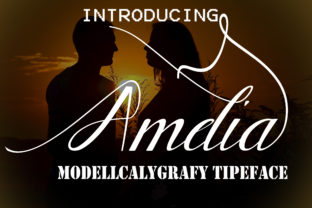
Amelia is a modern calligraphy font crafted entirely by hand by Imun Studio, part of the Script Amp collection—a thoughtful curation of expressive, commercially viable script fonts built for real makers. What sets Amelia apart isn’t just its elegance, but its groundedness. It carries the soul of analog lettering—slight irregularities, organic rhythm, natural entry and exit strokes—but with the polish and consistency needed for professional product use. It’s joyful without being cutesy, refined without feeling distant. Whether you’re printing a boutique tag or previewing a digital planner cover, Amelia invites attention—not because it shouts, but because it breathes.
I’ve used Amelia across so many touchpoints in my shop: on matte-finish sticker sheets for planners (where its open counters stayed crisp even at 8pt), on cream-colored wedding invitation suites (paired with a clean, airy sans serif like Montserrat Light for balance), and as the hero type on a rustic wooden welcome sign for a friend’s backyard ceremony. Each time, it added a layer of tactile warmth—like the difference between typing a note and writing one with your favorite pen.
For physical products, Amelia shines brightest at display sizes: 24pt and up. Think candle jar labels, tote bag prints, ceramic mug decals, or framed printable wall art. Its letterforms hold character without sacrificing legibility—even on curved surfaces or textured paper. On small stickers or delicate gift tags? Stick to short phrases or single words (“Joy,” “Hand-Poured,” “Est. 2023”) and avoid tight spacing. I tested it on a Cricut Explore Air 2 with vinyl—no issues cutting at 16pt with standard blade settings, thanks to its well-defined outlines and moderate swash length.
It’s not designed for long paragraphs or body text—and that’s by beautiful intention. Amelia is a display font, meant to anchor, invite, and elevate. Use it for names, titles, greetings, seasonal headers (“Cozy Season,” “Spring Gatherings”), shop logos, or signature lines on greeting cards. For anything longer—like care instructions on a product label or a story blurb in a printable journal—you’ll want to pair it thoughtfully. My go-to combo? Amelia with a relaxed, low-contrast sans serif (think Poppins Regular or Lato). The contrast gives clarity without competing. Occasionally, I’ll layer it over a quiet serif like Merriweather for editorial-style printable wall quotes—Amelia for the title, the serif for the quote body. Never force two scripts together; let Amelia lead, then step back.
One of the quiet joys of working with Amelia is discovering its built-in personality shifts. The font includes stylistic alternates and ligatures—subtle variations on letters like “f”, “t”, and “&”—that add nuance when enabled in design apps like Adobe Illustrator or Affinity Designer. A single toggle can soften a word’s ending or give a phrase extra flow. I used an alternate “y” on a set of holiday gift tags—it lent just enough whimsy without drifting from the font’s core sincerity.
Before launching any product—whether it’s a physical candle with printed labels or a digital download of wedding checklist pages—I always double-check the included file formats (OTF, TTF, WOFF) and confirm commercial licensing covers my use case. Amelia comes with full commercial rights for physical goods, printables, and merchandise—no hidden limits—as long as you’re using it as a design element (not reselling the font files themselves). If you're creating SVG cut files for Silhouette or Cricut users, make sure to outline the text before exporting. And if multilingual support matters for your audience—say, including French accents on boutique packaging—Amelia covers Latin-based languages thoroughly, including accented characters and punctuation that feel native, not tacked on.
What surprises me most about Amelia is how consistently it elevates perception—not just of the product, but of the maker behind it. Customers don’t say, “I love your font.” They say, “This feels special,” or “Everything looks so cohesive,” or “I can tell you put care into every detail.” That’s the quiet power of intentional typography: it doesn’t distract—it deepens. It turns a simple tea towel label into a keepsake. It makes a digital planner page feel like something you’d frame. It gives seasonal product photography a sense of calm authority, even when shot on a sunlit kitchen counter.
Whether you’re sketching mockups for spring botanical stickers, prepping a batch of handmade soap labels, or designing a minimalist wedding welcome board, Amelia meets you where you are—no overdesign required. It’s the kind of font that reminds you why you started making things in the first place: to connect, to express, to offer beauty that feels both personal and polished. And when your tools feel like collaborators—not just utilities—that’s when the work starts to sing.