Mistletoe: An Elegant Handwritten Font for Digital Branding
It started with a hero section—just me, a half-finished coaching website mockup, and that familiar pause before committing to a headline font. I’d tried three clean sans serifs, all technically sound but emotionally flat. Then I dropped Mistletoe into the H1 field, typed “You’re Exactly Where You Need to Be,” and felt the whole layout exhale. Not because it’s flashy—but because it carries warmth, intention, and quiet confidence. That’s when I knew this wasn’t just another script font. It was a brand voice in type.
What Makes Mistletoe Feel So Human on Screen
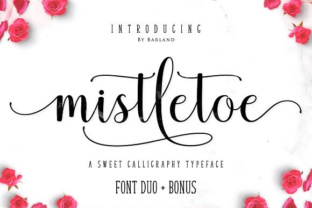
Mistletoe is a premium handwritten font duo by Barland.Note—designed not as a single weight or style, but as a thoughtful pair: one fluid, expressive script and a complementary supporting element (often a delicate swash or subtle alternate). As a color font (OpenType-SVG), it renders rich, layered strokes in compatible apps—and while SVG support varies across browsers, its OTF and TTF files ensure reliable fallbacks for web use via @font-face or design tools like Figma (with proper conversion) and Webflow (using hosted font services).
Visually, Mistletoe walks a graceful line between elegance and approachability. The letterforms have gentle pressure variation, soft entry/exit strokes, and just enough irregularity to feel handmade—not algorithmically perfect. It’s not overly ornate like Victorian scripts, nor too casual like doodle fonts. Instead, it reads as *considered*: the kind of handwriting you’d see on a beautifully composed welcome note from a trusted mentor or a boutique wellness brand.
Where Mistletoe Shines in Real Web Layouts
I tested Mistletoe across several live-use scenarios—no placeholder lorem ipsum, just real content, real constraints:
- Landing page headlines: On a product launch page, Mistletoe at 48px (desktop) and 36px (mobile) held clarity even over soft image overlays—especially with subtle text shadow or a light semi-transparent background bar.
- Section dividers & subheadings: Used at 28px in an “How It Works” section, it created instant visual rhythm without competing with body copy.
- CTA buttons: At 20px with tight letter-spacing and ample padding, it added personality to primary buttons—without sacrificing tap target size or mobile readability.
- Blog headers & featured quotes: Paired with a warm, airy serif (like Cormorant Garamond) for body text, Mistletoe gave editorial depth to a client’s wellness blog—making quotes feel intimate, not decorative.
Crucially, it scaled cleanly. No jagged edges on retina displays. No awkward spacing collapse at smaller sizes. And because Barland.Note included multiple stylistic alternates and ligatures, I could fine-tune awkward letter pairs (“Th”, “Wa”, “ff”) directly in Illustrator or Figma—then export crisp SVGs for web icons or hero accents.
Smart Pairing & Practical Web Considerations
Mistletoe is a display font—not meant for paragraphs, navigation menus, or form fields. But that’s its strength. Use it where you want to signal care, craft, and connection. For everything else, lean into contrast: pair it with a highly legible, neutral sans serif (like Inter, Poppins, or even system fonts like -apple-system) for body text, captions, and UI labels. This pairing builds hierarchy naturally and supports accessibility—especially for users relying on screen readers or preferring reduced motion.
I also checked licensing carefully: Mistletoe’s commercial license covers web embedding (with proper hosting), client projects, SaaS dashboards (where displayed, not edited), and digital templates—as long as end users aren’t redistributing the font files themselves. For open-source or CMS-based sites, I converted the OTF to WOFF2 using a trusted tool and confirmed load times stayed under 25KB—well within performance best practices.
When to Reach for Mistletoe—and When to Pause
Reach for Mistletoe when you need:
- A distinctive yet trustworthy voice for a creative portfolio or service-based site
- Emotional resonance in a course sales page or coaching offer
- Elevated visual identity for a boutique online store or artisan brand
- Authentic warmth in a nonprofit campaign or community initiative landing page
Pause before using it for:
- Mobile navigation labels (too delicate at small sizes)
- Long-form blog posts or documentation (low legibility density)
- High-contrast dark mode interfaces without testing stroke clarity
- Interfaces requiring WCAG AA+ contrast compliance for headings (test with axe or Lighthouse—some swashes may fall short without background adjustment)
One final note: Mistletoe’s charm lives in restraint. I found that using it for *one* key headline per viewport—and echoing its rhythm through custom icon strokes or spacing cadence—created stronger brand recall than sprinkling it everywhere.
More Than a Font—A Design Decision With Heart
In a landscape full of interchangeable sans serifs and algorithmically optimized type, Mistletoe stands out by honoring the human hand behind the brand. It doesn’t shout. It leans in. And in web design—where first impressions happen in under two seconds—that quiet confidence makes all the difference. Whether you're launching a new course, refining a studio’s digital presence, or crafting a heartfelt campaign page, Mistletoe isn’t just typography. It’s the first sentence of a conversation you want people to stay in.