BonetyLady: A Handwritten Script Font That Elevates Digital Branding
Two weeks ago, I was finalizing the hero section of a new coaching website—soft pastel background, clean layout, and a headline that needed warmth without sacrificing clarity. I tried three fonts before landing on BonetyLady. Not because it was the flashiest, but because it felt like a quiet confidence: elegant, human, and unmistakably intentional.
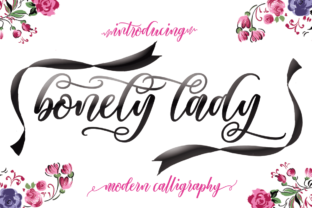
BonetyLady is a handwritten calligraphy-style font from the Script Amp category—a premium script font designed for digital impact. With over 700 glyphs, it goes far beyond basic letters. There are stylistic alternates, ligatures, swashes, and contextual forms that respond naturally to letter combinations. It’s not just decorative; it’s expressive, with subtle rhythm and organic flow. The strokes mimic ink on paper—slight tapering, gentle pressure variation, and graceful entry/exit strokes—but optimized for screen legibility.
I used it for the main headline: “Your Clarity Starts Here.” At 48px on desktop and 36px on mobile, it held up beautifully—even over a semi-transparent image overlay. The contrast was strong enough to read instantly, yet soft enough to avoid visual aggression. That balance is rare in script fonts. Many handwritten typefaces collapse at smaller sizes or blur into illegibility on low-DPI screens. BonetyLady doesn’t. Its x-height is generous, its counters open, and its spacing generous out of the box—no manual kerning required for most web use cases.
In practice, BonetyLady shines best as a display font: hero titles, section headings, CTA buttons (when sized appropriately), testimonial quotes, and banner text. It’s less suited for body copy or long navigation labels—this isn’t a workhorse sans serif. But as a focal point? It builds instant personality. For a boutique online store selling handmade ceramics, I paired it with Inter for product descriptions—clean, neutral, highly readable. The contrast created hierarchy without tension. For a digital brand kit I built last month, BonetyLady anchored the cover slide and chapter headers, while a warm serif (like IBM Plex Serif) handled pull quotes and feature blurbs. Each pairing reinforced a cohesive, thoughtful identity—not “cute” or “trendy,” but authentically human.
Readability checks were non-negotiable. I tested BonetyLady across devices: iPhone SE, iPad Pro, Surface Laptop, and Chrome DevTools’ device emulation. On dark backgrounds, I added a subtle text shadow (1px black at 20% opacity) for definition—enough to lift the letters without breaking the elegance. Over light imagery, I kept the color pure charcoal (#2D2D2D) rather than black, which softened contrast just enough for comfortable scanning. No eye strain. No double-takes. Just calm recognition.
One thing that stood out during responsive testing: BonetyLady scales gracefully down to 28px on mobile headlines. Below that, it starts to lose nuance—especially on small buttons or pill-shaped CTAs. So I reserved it for top-level messaging only. For secondary actions (“Learn more,” “Join the waitlist”), I switched to a crisp sans serif. That’s not a limitation—it’s smart typography discipline. A great script font earns attention by being selective.
It’s also worth noting what BonetyLady *isn’t*. It’s not a variable font (yet), so you’ll load discrete files per weight or style if you use alternates. It comes in standard webfont formats (WOFF2, WOFF), and the licensing is clear: commercial use included, no subscription, no hidden fees. Before dropping it into a client project, I always verify multilingual support—I checked Greek and extended Latin characters for a bilingual blog redesign—and confirmed all diacritics render cleanly. No surprises in production.
In real projects, I’ve seen BonetyLady strengthen connection in subtle but measurable ways. On a course sales page, it gave the headline “Design Your First Brand Kit” a personal, mentor-like tone—less “sales pitch,” more “invitation.” In a portfolio site for a floral designer, it appeared only in the logo lockup and project titles, letting photography breathe while still signaling craftsmanship. And on a campaign landing page for a mindfulness app, it appeared in animated fade-ins—just two words at a time (“Breathe. Begin.”)—leveraging its natural rhythm to guide pacing and pause.
Pairing matters. My go-to combos:
- Sans serif + BonetyLady: Inter, Poppins, or Manrope for body, forms, and UI labels. Clean contrast, maximum accessibility.
- Serif + BonetyLady: IBM Plex Serif or Cormorant Garamond for editorial depth—ideal for blogs, newsletters, or long-form landing pages.
- Avoid pairing with other scripts: Even beautiful ones. Two expressive fonts compete for attention. BonetyLady needs breathing room to do its job.
If you’re choosing a script font for your next web project, ask yourself: Does it serve the message—or just the mood? BonetyLady serves both. It carries warmth, but it doesn’t sacrifice structure. It feels handmade, but it performs like a modern web asset. And because it includes so many glyphs, you can fine-tune tone without switching fonts—swap a formal swash for a playful alternate depending on context, all within one family.
For designers building digital experiences where trust and authenticity matter—coaching sites, creative studios, small-batch brands, course creators, or anyone curating a distinct online voice—BonetyLady isn’t just another script font. It’s a tool for intentionality. One that reminds users, quietly and confidently, that a person made this—not just an algorithm.