Miletta: A Hand-Painted Script Font That Elevates Digital Branding
There it was—my third revision of the hero section for a boutique coaching site—and something still felt off. The headline was clear, the CTA button strong, but the voice lacked warmth. I swapped out the clean sans serif I’d been using and dropped in Miletta. Instantly, the layout softened, humanized, and leaned into intention. Not just “a font,” but a quiet gesture: ink on paper, brush held with care, then thoughtfully digitized by Blessed Print. That’s the magic of Miletta: it doesn’t shout—it invites.
What Makes Miletta Feel So Authentically Human Online
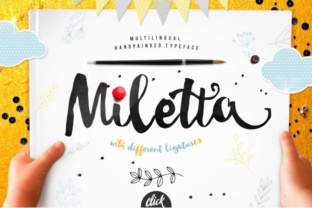
Miletta is a hand-painted script font, part of the Script Amp category—a thoughtful niche for expressive, high-character typefaces. Created with real brush and ink, then scanned and refined to pixel-perfect clarity, it carries subtle texture, natural variation in stroke weight, and gentle organic flow. Unlike many digital scripts that feel overly uniform or artificially bouncy, Miletta breathes. Its lowercase letters have graceful entry and exit strokes; capitals include delicate swashes that don’t overwhelm; and the rhythm feels like handwriting you’d trust—calm, confident, and quietly intentional.
I tested it across devices: desktop, tablet, and mobile—and its charm held up best at larger sizes where its expressive details could shine. On mobile, I kept it to headlines and short accent phrases (like “Welcome” or “Begin Here”) rather than body text, and paired it with a crisp, highly legible sans serif like Inter or Poppins for contrast and clarity. That pairing became the foundation of the entire site’s typographic hierarchy.
Where Miletta Shines in Real Web Layouts
In practice, Miletta works beautifully in places where emotional resonance matters more than dense information:
- Hero headlines—especially over soft-focus imagery or muted color blocks. Its fluidity creates instant visual harmony without competing.
- Landing page section titles, like “How It Works” or “Your Journey Starts Here,” where personality reinforces positioning.
- CTA buttons with short action verbs (“Start Now,” “Join Us,” “Explore”)—just one or two words, set large enough to read comfortably on all screens.
- Blog headers and newsletter banners, adding editorial warmth to otherwise functional content areas.
- Digital brand kits and style guides, where Miletta serves as the expressive anchor—paired with supporting fonts for consistency and flexibility.
On a recent product landing page for a digital planner suite, I used Miletta for the main headline (“Designed for Deep Focus”) and the subheading (“Handcrafted templates, thoughtfully built”). The contrast between Miletta’s tactile energy and the clean, airy body copy created a sense of craftsmanship—exactly what the audience associated with premium digital tools.
Readability & Responsiveness: What to Watch For
Miletta is not built for long paragraphs, form labels, navigation menus, or small interface elements. Its decorative nature means it loses clarity below ~24px on desktop and ~20px on mobile—especially on lower-resolution screens or when rendered over busy backgrounds. I always test it against dark mode and light mode, and found it performs best on light or mid-tone backgrounds with generous letter spacing (I used letter-spacing: .03em in CSS for balance).
For image overlays, I added a subtle semi-transparent background behind the text or used a soft text shadow to ensure contrast—never relying solely on font weight. And while Miletta includes stylistic alternates and ligatures (great for avoiding awkward letter collisions), I limited those to larger display settings. Overusing swashes in tight spaces or on mobile can create visual noise instead of elegance.
Smart Pairing & Practical Implementation
Pairing Miletta well is key to unlocking its full potential. I consistently pair it with a neutral, highly readable sans serif—something with open counters and friendly proportions. Inter, Manrope, and Lato all work beautifully as secondary fonts for body, captions, and UI elements. For a more editorial or luxury-leaning site, a refined serif like Cormorant Garamond adds quiet sophistication without competing.
Before deploying Miletta on any live project, I checked the included webfont formats (WOFF2 is ideal for performance), confirmed multilingual support covered my client’s needs (it includes Latin-based languages with extended diacritics), and verified the commercial license permits use on client websites and SaaS platforms. Blessed Print’s licensing is clear and maker-friendly—no surprises when scaling from portfolio to production.
When to Reach for Miletta—and When to Pause
Reach for Miletta when you want to signal authenticity, care, and creative intention—on a portfolio homepage, a wellness brand’s about page, a course sales page, or a boutique online store’s banner. It adds warmth without sacrificing polish, and helps differentiate a digital experience in a sea of generic type.
Pause before using it for accessibility-critical elements (like error messages or required form fields), dense dashboard interfaces, or any context where speed, scannability, or universal legibility must come first. It’s a display font—not a workhorse—and that’s its strength.
What stays with me isn’t just how Miletta looks, but how it makes visitors *feel*: seen, welcomed, and gently guided. In a world of fast-scrolling, algorithm-driven attention, a hand-painted script font like this reminds us that thoughtful design still begins with the human hand—and ends with connection.