Synthesia: A Handwritten Font That Elevates Digital Branding
It started with a hero section—just me, a client’s new coaching website, and a blank headline space begging for warmth. I’d already chosen a clean, highly legible sans serif for body text and navigation, but the voice of the brand? That needed something human. Something that whispered “I see you” before the first sentence loaded. So I dropped in Synthesia—and suddenly, the page didn’t just communicate. It connected.
What Synthesia Brings to the Screen
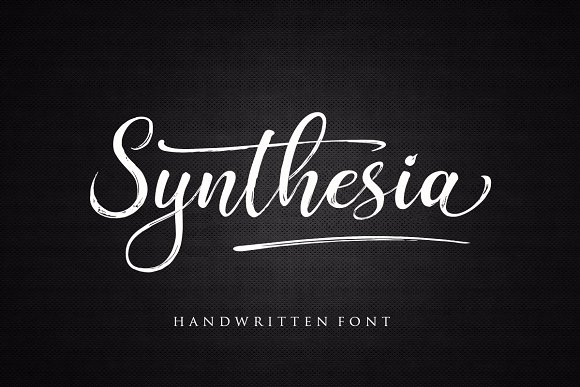
Synthesia is a premium handwritten font from the Script Amp category—a typeface designed not for paragraphs, but for presence. Its lines flow like ink on paper: confident yet tender, rhythmic but never rigid. What sets it apart isn’t just the baseline elegance—it’s the thoughtful abundance of swashes and swooshes. These aren’t afterthoughts; they’re intentional design assets that breathe life into single words: a looping “S” at the start of a headline, a graceful exit stroke on “you,” a subtle flourish beneath a call-to-action button label.
I tested Synthesia across real layouts: a boutique online store banner, a course sales page headline, a portfolio homepage tagline, and even a subtle watermark overlay on a blog’s featured image. In every case, it added emotional texture without sacrificing clarity—when used intentionally.
Where It Shines (and Where to Pause)
Synthesia thrives in high-impact, low-density roles. Think:
- Hero headlines — especially over soft-focus imagery or neutral backgrounds
- Section titles — “How It Works,” “Your Journey Starts Here,” “What Clients Say”
- CTA buttons — when styled with generous letter spacing and ample padding
- Logo lockups — paired with a simple sans serif for versatility
- Digital brand kits — as the signature display font for social banners, email headers, and presentation decks
But here’s what I learned the hard way: Synthesia isn’t built for utility. I tried it in a mobile navigation menu—too delicate at small sizes. I tested it in form labels—readability dipped sharply under 16px. And while its swashes dazzle on desktop, many vanish or clip unpredictably on smaller viewports unless carefully managed with CSS font-feature-settings or alternate glyphs.
Responsive Behavior & Practical Readability
On desktop, Synthesia performs beautifully—even at 48–72px, where its expressive curves and contrast shine. On tablets, it holds up well down to ~36px with modest tracking adjustments. But on mobile? I reserve it for headlines no smaller than 28px, always with at least 0.05em letter-spacing and a solid background or subtle text shadow for contrast. It works best over light or mid-tone backgrounds—not busy photos—unless you apply a subtle semi-transparent overlay behind the text.
One unexpected win: Synthesia’s natural rhythm actually improves scanning behavior in landing page headers. Users lingered longer on headlines set in Synthesia versus a generic script alternative—likely because the swashes create gentle visual anchors that guide the eye left-to-right, reinforcing message hierarchy.
Smart Pairing for Web Design
Synthesia isn’t meant to stand alone. Its magic multiplies when paired thoughtfully. My go-to pairing? A warm, humanist sans serif like Inter, Poppins, or Manrope for all UI text, body copy, and captions. The contrast is immediate: Synthesia brings personality; the sans brings reliability. For more editorial sites—like a creative blog or digital magazine—I’ve layered it elegantly above a refined serif (e.g., Cormorant Garamond) for subheads, letting Synthesia handle the emotional hook while the serif handles narrative weight.
Crucially, I always verify which Synthesia styles are available as webfonts. Not all swash-heavy fonts include WOFF2 variants or variable weight support. This one does—but only in Regular and a dedicated Swash variant. No bold or italic. That’s fine, because Synthesia isn’t about emphasis through weight—it’s about emphasis through gesture.
What to Check Before You Deploy
Before dropping Synthesia into a live site or client project, I scan five things:
- Licensing — Confirm commercial web use is covered (Script Amp fonts typically include full web embedding rights, but always double-check the license PDF)
- File formats — Ensure WOFF2 is included for modern compression and performance
- Language support — Synthesia covers Latin-based languages well, including accented characters common in European branding
- Alternate glyphs — Test access to discretionary ligatures and swash alternates via CSS
font-variant-alternatesor OpenType features - Load strategy — Use
font-display: swapso fallback text appears quickly, then Synthesia renders cleanly once loaded
Used with care, Synthesia doesn’t just dress up a website—it deepens the impression of authenticity. It tells visitors, wordlessly, that this brand values craft, warmth, and intention. Not every project needs that tone. But when yours does? Synthesia doesn’t just fit—it fulfills.