Aspades: A Handwritten Font for Authentic Digital Branding
As a UI designer who builds landing pages, SaaS dashboards, and boutique e-commerce experiences, I choose fonts not just for aesthetics—but for behavior. How does a typeface guide the eye? Does it reinforce tone without sacrificing clarity? Does it scale across devices while preserving personality? That’s why Aspades stands out in my toolkit: it’s a handwritten font built from real pen-on-paper rhythm—my own handwriting—and infused with the quiet elegance of F. Scott Fitzgerald’s prose from The Great Gatsby. It’s not a generic script. It’s intentional, literary, and digitally grounded.
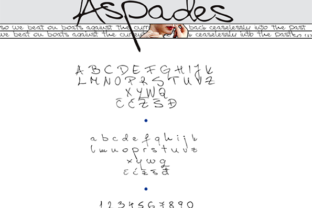
Visually, Aspades balances warmth and restraint. The strokes have natural variation—slight tapering, subtle pressure shifts, gentle slant—but avoid excessive flourishes that break readability at small sizes. It’s a script font, yes, but one designed for screen-first use: generous x-height, open counters, and consistent spacing that holds up in hero sections, mobile headers, and even inline decorative accents. Unlike many display fonts that collapse on smaller viewports, Aspades retains legibility down to 24px on light backgrounds—and with thoughtful contrast, works cleanly on dark mode interfaces too.
Where Aspades Earns Its Place in Real Layouts
In practice, Aspades shines where authenticity and emotional resonance matter most:
- Hero section titles—paired with a neutral sans serif (like Inter or Manrope) for body copy, Aspades creates instant visual hierarchy and sets narrative tone before users scroll.
- Landing page subheads and quote blocks—its literary origin makes it ideal for testimonials, founder statements, or value-driven messaging in coaching sites, creative courses, or editorial newsletters.
- Online store banners and product feature tags—especially for brands with artisanal, vintage, or literary positioning (think indie bookshops, writing tools, or curated lifestyle goods).
- Portfolio site headers and project titles—adds human texture without compromising professionalism; perfect for designers, writers, and photographers building personal brand identity.
- CTA buttons and limited-use accents—use sparingly (e.g., “Begin Your Story” instead of “Get Started”) to elevate conversion-focused microcopy with emotional weight.
It’s not meant for long paragraphs or data-dense UI tables. Aspades is a display font—a strategic voice, not background noise. Think of it as your brand’s signature in ink: present at key moments, then recede gracefully.
Readability & Responsiveness: Practical Considerations
On mobile, Aspades performs best above 28px in headings and never below 20px—even then, only for short labels over high-contrast backgrounds. For image overlays (e.g., hero banners with photos), I always apply a subtle semi-transparent dark or light scrim behind the text to ensure contrast meets WCAG AA standards. On dark backgrounds, I reduce letter-spacing slightly and avoid thin weights—luckily, Aspades ships with a single, well-tuned weight optimized for screen rendering.
It includes standard Latin character sets and basic punctuation—sufficient for English-language web projects, blogs, and digital ads. While it doesn’t support extended multilingual glyphs, its clean structure means it pairs naturally with robust webfonts like Lora (for serif pairing) or Open Sans (for accessible sans serif contrast). No alternates or stylistic sets are included, which keeps file size lean and loading predictable—a win for performance-focused layouts.
Font Pairing That Builds Trust, Not Clutter
Successful typography isn’t about stacking decorative fonts—it’s about contrast with purpose. With Aspades, I consistently pair it with a highly legible, low-contrast sans serif for body text, navigation, and form fields. Why? Because the script’s personality needs breathing room to land. A tight, modern sans (like Poppins or Space Grotesk) offsets Aspades’ organic flow without competing. For more editorial or luxury-facing sites—say, a literary magazine or premium stationery brand—I’ll swap in a refined serif like Crimson Pro or Playfair Display for subheads, letting Aspades anchor only the most evocative lines (“So we beat on, boats against the current…”).
This pairing strategy strengthens brand trust: users subconsciously register consistency, intentionality, and attention to detail. When Aspades appears only where it adds meaning—not decoration—it signals confidence in voice and design discipline.
Licensing for Real-World Use
Aspades is a commercial font distributed through Script Amp, and its license covers all common digital use cases: live websites (via self-hosted @font-face or CDN), client landing pages, SaaS UIs, online stores (Shopify, Webflow, WordPress), email templates, and downloadable brand kits. You can embed it in digital products you sell—as long as end users aren’t redistributing the font files themselves. No subscription, no monthly fee: it’s a one-time purchase that becomes a permanent part of your design assets library.
For agencies or studios managing multiple client sites, verify the extended license tier—but for solo designers, founders, and small teams shipping focused digital experiences, the standard license covers everything from portfolio sites to course sales pages and social media graphics.
If your work lives at the intersection of storytelling and interface—where every pixel supports a feeling, not just function—Aspades delivers more than style. It delivers continuity. A handwritten font rooted in literature, built for screens, and calibrated for impact: not as ornament, but as intention made visible.