Fraulein Revival: A Modern-Vintage Typeface That Just *Works*
It started with a blank brand board and a client email that read: “We want something warm, intentional, and quietly confident—like the kind of place you’d linger over a second cup.” No mood board yet. No logo sketch. Just that sentence—and the quiet pressure of knowing the right typeface would carry half the story.
I opened my font library and scrolled past the usual suspects. Then I paused on Fraulein Revival. Not because it was trending, but because it felt like stepping into a sunlit corner of a well-loved café—slightly worn, thoughtfully detailed, and unmistakably human.
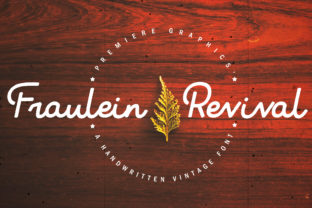
Fraulein Revival is a script amp typeface, but it’s not fussy or overly ornate. It balances vintage charm—think subtle ink bleed, gentle swashes, and organic stroke contrast—with clean modern rhythm. The lowercase ‘g’ has a soft, open loop; the uppercase ‘S’ flows like liquid ink pulled just right across paper. It’s expressive without shouting, elegant without stiffness. And crucially, it doesn’t pretend to be handwriting—it’s a considered script font, designed for clarity and character in equal measure.
My first test? A simple wordmark: the café’s name, set in Fraulein Revival at 48pt on a cream linen texture. Instantly, it felt grounded—not retro in a costume-y way, but timeless in how it sat beside hand-drawn botanical line art and matte ceramic photography. The weight holds up beautifully at larger sizes, making it ideal as a display font for logos, signage, and hero headers. On a shop sign mockup, it read clearly from six feet away. On a business card, it added tactility—even digitally, the subtle texture of its outlines suggested warmth and craft.
Where Fraulein Revival really surprised me was in versatility. I used it for the café’s menu header (paired with a relaxed serif for body text), then dropped it into Instagram story templates for seasonal specials—“Honey Lavender Latte” looked inviting, not precious. For product labels—small-batch oat milk and house-roasted beans—I scaled it down to 16–20pt. It held its shape, though I kept those uses short-form: names, descriptors, icons only. It’s not built for long paragraphs, and that’s fine. That’s what makes it a strong accent font, not a workhorse.
Pairing it was intuitive. With a warm, low-contrast serif like Adobe Garamond or LM Serif, Fraulein Revival gained quiet sophistication. Against a friendly, open-counters sans like Inter or Manrope, it popped with personality while keeping the system legible and balanced. I avoided pairing it with other scripts—too much motion—but found it played nicely alongside minimalist handwritten fonts for occasional quotes or chalkboard-style accents.
One practical note: Fraulein Revival includes stylistic alternates and ligatures, which added nuance when refining the final logo. Turning on the swash ‘y’ or the connected ‘f-i’ pair gave options without needing a separate font family. It also supports extended Latin characters—enough for English, French, Spanish, and German use—so no hiccups with café names or ingredient lists. File formats include OTF and WOFF2, so it’s ready for both print design assets and web implementation.
Licensing is straightforward: a commercial font license covers everything from packaging design to social media graphics, merch, and client deliverables. No need to second-guess whether the tote bag or website banner falls under usage terms—just design with confidence.
In practice, Fraulein Revival shines where tone matters most: logo design, packaging design, editorial design for zines or seasonal lookbooks, printed marketing materials like flyers and posters, and even website headers where a strong visual hook sets the mood before a single word is read. It works especially well for small businesses rooted in craft—skincare studios, handmade shops, local bakeries, creative studios—that want authenticity without cliché.
I did one quick test before locking anything in: printed three versions of the same label mockup—one with Fraulein Revival, one with a generic script, one with a bold sans. My client pointed straight to the Fraulein version and said, “That one feels like *us*.” Not because it was fanciest, but because it carried intention—not just style, but voice.
That’s the quiet strength of this typeface. It doesn’t dominate a layout; it elevates it. It doesn’t chase trends; it invites pause. And unlike some premium fonts that demand attention, Fraulein Revival earns it—through consistency, readability at key sizes, and a mood that translates across mediums.
If you’re building a brand identity and wondering whether a script font can feel professional *and* personable, Fraulein Revival is worth testing early. Try it on your logo draft first. Then drop it into a product label, a social post template, and a simple letterhead. See how it behaves—not just how it looks. You’ll notice how the curves soften sharp edges in a layout, how the spacing creates breathing room, how even a single word in Fraulein Revival can shift perception from “generic” to “thoughtful.”
It’s not a font for every project. But for the right one—the one where warmth, craft, and quiet confidence matter most—it’s more than a type choice. It’s part of the story you’re telling.
- Best used as a display font, logo font, or accent font—not for body text
- Pair with a warm serif or neutral sans serif for balance and hierarchy
- Test at real-world sizes: 24pt for signage, 16–20pt for labels, 48+pt for logos
- Enable ligatures and alternates selectively—they add polish, not clutter
- Verify multilingual support matches your project’s language needs before finalizing
At the end of the day, typography isn’t just about aesthetics—it’s about resonance. And Fraulein Revival resonates. Not loudly, but clearly. Like steam rising off a fresh pour, or the quiet hum of a well-run kitchen. That’s why it lives in my go-to folder now—not as a novelty, but as a reliable tool in the Fonts category, and one I reach for whenever a project asks for something both modern and meaningfully vintage.