Wootter: A Modern Calligraphy Font for Editorial Design
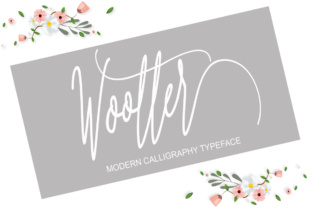
As someone who crafts blogs, digital magazines, ebooks, and printable guides—day in and day out—I pay close attention to how type shapes tone, guides the eye, and quietly signals intention. Wootter stands out in the Script Amp category not as a nostalgic flourish or an overly ornate script, but as a thoughtfully engineered modern calligraphy font built for clarity, rhythm, and quiet confidence. Its strokes balance fluidity with structure: subtle contrast between thick and thin lines, gentle entry and exit strokes, and open counters that breathe on screen and on paper.
What makes Wootter especially valuable for editorial work is its restrained elegance. It avoids the theatrical looseness of some handwritten fonts while staying far removed from rigid, mechanical scripts. That middle ground—where warmth meets precision—is where Wootter lives. It’s expressive enough for a lifestyle blog’s masthead, refined enough for a literary magazine cover, and distinctive enough to anchor a creator’s brand identity across newsletters, worksheets, and digital downloads.
In practice, Wootter shines most powerfully in display roles. Use it for article headlines that need personality without sacrificing legibility at 36–48px on desktop or even 28px on mobile. Try it for ebook chapter openers—its natural rhythm invites pause and sets narrative tone before a single paragraph begins. For quote graphics in newsletters or social media posts, Wootter adds human texture without competing with the message. Its letterforms hold up well in SVG exports and high-DPI PDFs, making it reliable for printables like coaching workbooks, wedding planning checklists, or seasonal recipe guides.
Wootter isn’t designed for extended body copy—and that’s by thoughtful intent. Like many strong script fonts, it thrives in moments of emphasis: section headings in digital magazines, title treatments on printable planners, logo lockups for independent content brands, or stylized accents in email headers. When used intentionally, it creates visual hierarchy not through size alone, but through contrast—pairing beautifully with a highly readable serif font (like Merriweather or Crimson Text) for long-form articles, or a clean, neutral sans serif (such as Inter or Lato) for captions, navigation, and supporting text.
Font pairing matters deeply in editorial design—not just aesthetically, but functionally. Wootter’s moderate x-height and consistent baseline make it stable when set alongside both serif and sans serif companions. Its lowercase ‘a’, ‘g’, and ‘e’ are open and unambiguous, reducing ambiguity at smaller sizes. And because it’s part of the Script Amp collection, Wootter includes stylistic alternates and discretionary ligatures that let you fine-tune voice: swap in a more formal ‘&’ for a brand guide, or choose a looser ‘t’ for a playful newsletter banner. Check the included weights—Wootter offers Regular and Bold, giving flexibility across mediums without overcomplicating your type stack.
For creators building digital products—think paid newsletters, downloadable templates, or client-facing publications—licensing is practical, not peripheral. Wootter is a commercial font with clear usage terms covering ebooks, web embeds, SaaS platforms, print runs, and digital downloads. That means you can confidently use it in a course workbook sold on Gumroad, a branded planner hosted on Notion, or a subscriber-only guide distributed via Substack—no last-minute licensing surprises. It’s also optimized for multilingual support across Western European languages, so if your audience spans the UK, Canada, Australia, or parts of Europe, diacritics and punctuation remain crisp and correctly spaced.
Consider how Wootter works in real editorial contexts. A food blogger might use it for recipe titles and ingredient headers—its soft curves echoing the tactile joy of cooking—while setting method steps in a warm serif. A wellness coach could apply Wootter to worksheet headers (“Your Weekly Intentions”, “Breath & Balance Tracker”) and pair it with a light sans for instructions, creating a calm yet intentional visual rhythm. A digital magazine focused on craft and slow living might feature Wootter on covers and pull quotes, then switch to a classic serif for interviews and essays—letting the script do emotional heavy lifting while the body type carries clarity.
Readability on screen remains a top priority. Wootter renders cleanly across modern browsers and major email clients when embedded via @font-face or system fallbacks. On mobile, it holds its character at headline sizes without blurring or crowding—especially when line height is adjusted to 1.2–1.35. In PDF exports, its OpenType features stay intact, preserving ligatures and alternates in final deliverables. For print, its ink traps and spacing ensure sharpness even at 12pt in small-format booklets or folded guides.
What separates Wootter from other modern typography options is its editorial intelligence. It doesn’t shout—it invites. It doesn’t mimic handwriting; it interprets it with purpose. That makes it especially effective for creators building recognizable, repeatable brand language—not just one-off graphics, but cohesive systems: a consistent header style across 50 blog posts, matching ebook and printable assets, or unified typography across a suite of digital products. In an ecosystem crowded with decorative fonts, Wootter earns its place by serving the reader first, then the designer.
If you’re selecting a premium font to strengthen your publication’s voice—whether you’re designing a quarterly digital zine, launching a subscriber-based newsletter, or packaging a set of guided journals—you’ll find Wootter both versatile and dependable. It supports mood without dictating it, enhances hierarchy without overwhelming it, and adds distinction without demanding attention. That balance is rare. And for anyone committed to thoughtful, reader-centered editorial design, it’s exactly what a modern typeface should do.