Santa Rose: A Designer’s Real-World Script Review
First Glance: Warm, Confident, and Quietly Luxe
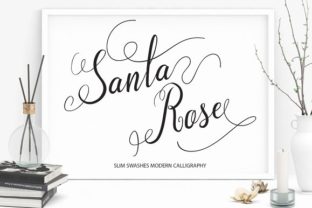
Opening Santa Rose for the first time, I didn’t see “another script font.” I saw a typeface with breath—slight swelling in the downstrokes, soft but intentional terminals, and a rhythm that feels handwritten without sacrificing polish. It’s not fussy or overly ornate, nor is it stripped-down to the point of losing soul. Santa Rose lands in that rare middle ground: warm enough for artisanal brands, structured enough for premium packaging, and distinctive enough to hold its own in editorial design or social media graphics. It reads as modern typography with quiet confidence—not shouting, but leaning in.
Where Santa Rose Earns Its Keep
In logo design, Santa Rose shines when paired with restraint. It works beautifully as a primary wordmark for small-batch skincare lines, indie book publishers, ceramic studios, or boutique bakeries—brands where authenticity and tactile quality matter more than scale. As part of a broader brand identity, it pairs naturally with a clean sans serif (think Inter or Poppins) for body copy, letting Santa Rose carry voice while the supporting type handles clarity and hierarchy.
For packaging design—especially product labels on glass jars, linen tags, or matte-finish boxes—Santa Rose adds immediate perceived value. Its subtle contrast and open counters hold up well at 10–14pt on physical goods. I’ve used it successfully on candle labels, tea tins, and greeting card suites where legibility at arm’s length matters, and it delivered every time.
In digital contexts, Santa Rose excels in hero headers, blog post titles, and social media graphics—but only when sized appropriately. At 36pt+ on websites or Canva templates, it commands attention without overwhelming. On Instagram carousels or Pinterest pins, it elevates quotes and short calls-to-action, especially against muted or natural-toned backgrounds. For Cricut projects and printable design, it cuts cleanly and renders crisply in SVG exports, making it a reliable commercial font for crafters selling digital products.
Where to Pause—and Why
Santa Rose is not a workhorse. It’s a display font with purpose. Don’t use it for body text, long paragraphs, or interface labels. Its lowercase ‘a’, ‘g’, and ‘e’ are elegant but reduce readability below 16pt in most real-world conditions—especially on screens or low-DPI print. I tested it in black and white on uncoated paper: still strong, but spacing tightened visibly. Always check small-size readability in context—not just in Font Book or Google Fonts preview.
Avoid all-caps settings unless you’re using it for a single decorative accent (e.g., “EST. 2021” beneath a logo). Uppercase letters lose some of Santa Rose’s organic flow and feel less cohesive. And while it’s technically a script font, it’s not a handwritten font—so don’t lean into “casual” or “playful” brand voices expecting spontaneity. It’s refined, not scribbled.
Real Talk on Readability & Trust
Readability isn’t just about letterforms—it’s about how a font shapes audience perception. Santa Rose supports trust because it signals care: deliberate spacing, consistent stroke modulation, and no visual shortcuts. That translates directly to brand consistency across touchpoints—from email headers to merchandise tags. When used thoughtfully, it reinforces professionalism without coldness. But overuse dilutes impact. I limit Santa Rose to one or two strategic placements per layout: a logo, a headline, or a pull quote. Anything more blurs hierarchy and weakens recognition.
Practical Designer Notes You’ll Actually Use
- Test it in black and white first. Santa Rose relies on contrast—not color—to communicate weight and form. If it reads well without gradients or outlines, it’s ready.
- Try it on real mockups—not just screens. Print a sample label, hold it at reading distance, and walk away ten feet. Does the rhythm hold? Does the x-height stay legible?
- Compare case treatments. Lowercase delivers Santa Rose’s best personality; uppercase should be reserved for tight, intentional accents.
- Review spacing in context. Kerning looks great in isolation, but test phrases like “The Olive Press” or “Wild & Co.”—watch for awkward gaps around ‘f’, ‘t’, and ‘y’.
- Pair it deliberately. Try Santa Rose beside a sturdy serif font (like Playfair Display) for luxury editorial layouts—or a neutral sans serif (like Manrope) for clean, contemporary brand systems. Avoid pairing with other script fonts or overly decorative display fonts; it competes, not complements.
- Confirm licensing early. Santa Rose is a premium font from Script Amp—licensed for commercial use, yes, but verify coverage for your specific needs: web embedding, app integration, or resale in design assets. Never assume.
Final Judgment: Not for Every Project—But Essential for the Right One
Santa Rose won’t solve vague branding problems or compensate for weak strategy. But in the hands of a designer who understands its limits and strengths, it becomes a precise tool: elevating a small business’s packaging, grounding a blogger’s visual voice, or adding warmth to a digital product’s launch campaign. It’s not trendy—it’s timeless-adjacent. Not flashy—it’s quietly confident. And unlike many script fonts that fade after three uses, Santa Rose holds up across seasons, clients, and formats.
If your project values craftsmanship, warmth, and understated distinction—if you’re building something meant to feel human, not algorithmic—Santa Rose earns a permanent spot in your type library. Just remember: respect its role. Let it lead where it belongs, and step back where it doesn’t. That’s how good typography serves design—and how Santa Rose earns its place in real work.