Honilad: A Warm, Human Script Font for Real Branding Work
There’s something quietly exciting about opening a fresh brand board—blank canvas, client mood board pinned to the side, and that first font test. Last month, I was developing visual identity for a small ceramic studio run by a potter who hand-throws every mug, glazes each piece in her backyard kiln, and signs her work with a quick, looping ink stroke. She didn’t want “perfect.” She wanted *present*. That’s when I dropped Honilad into the logo mockup—and everything clicked.
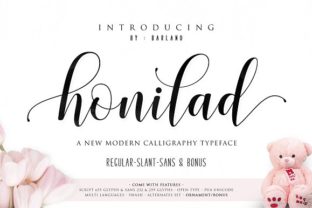
Honilad isn’t another slick, over-polished script. It’s a Script Amp typeface built on gentle imperfection: slightly uneven baseline alignment, subtle variation in stroke weight, and organic entry/exit strokes that mimic real pen movement. There’s no forced symmetry, no robotic consistency—just rhythm, breath, and warmth. It feels like handwriting you’d trust, not one you’d suspect was generated by an algorithm.
I started with the logo lockup—just the studio’s name in Honilad, set at 48pt on a soft oat-colored background. No effects. No shadows. Just the font, kerned carefully, letting those imperfect curves do the talking. It held up beautifully on screen, but more importantly, it translated with surprising clarity when scaled down to business card size. The lowercase “a” and “g” have distinct, friendly shapes—not too quirky, not too stiff—and the uppercase letters carry just enough presence for signage without shouting.
For packaging, I used Honilad exclusively for product names on matte-label stickers—think “Oat Milk Glaze,” “Ash-Fired Bowl,” “Winter Clay Series.” Paired with a quiet, neutral sans serif (I chose a clean, low-contrast geometric sans for body copy), Honilad became the voice of the maker, while the sans kept information legible and grounded. No need for bold weights or caps lock—Honilad’s natural contrast gives it inherent hierarchy, even at small sizes.
It shines brightest as a display font, especially in short-form contexts: shop window decals, Instagram story headers, limited-run poster series, and website hero text. On the studio’s homepage, I set the headline “Handmade, Not Mass-Produced” in Honilad at 64px. It felt personal—not performative. Visitors paused. They scrolled slower. That’s not magic; it’s typography doing its job: guiding attention, reinforcing tone, and building emotional resonance before a single word is read.
One thing I appreciated early on? Honilad’s thoughtful design for real-world use. It includes stylistic alternates—like a looser “s” or a more upright “y”—that let you fine-tune character flow without switching fonts. There are no ligatures to overcomplicate things, and the spacing between letters feels intuitive, not cramped or airy. It’s not a font that demands constant manual tweaking. You drop it in, adjust tracking by ±10, and move on—valuable time saved when juggling client revisions and production deadlines.
Readability is strong for a script—but with caveats. Honilad works best for headlines, logos, labels, and short phrases. I wouldn’t set a full product description or blog post in it. That’s not a flaw; it’s intentional design. As a logo font or accent font, it adds humanity without sacrificing polish. As a supporting typeface? Less so. It doesn’t blend quietly—it invites attention. And that’s exactly why it works so well for handmade, artisanal, or values-driven brands where authenticity is part of the message.
Font pairing is where Honilad really sings. I paired it with a warm, slightly rounded serif for printed lookbooks—something with open counters and modest contrast, like a contemporary Garamond variant. For digital use, a friendly humanist sans (think Meta or FF Meta) balanced its fluidity with structure. Avoid pairing it with other scripts or highly decorative handwritten fonts—that creates visual competition. Let Honilad lead, and give it breathing room with something calm and clear in support.
On physical materials, it performed consistently. Printed on uncoated paper? The slight ink spread softened the edges just right—enhancing its handmade feel. Laser-cut on wood signage? Crisp, elegant, and surprisingly legible from six feet away. Even on a simple black-and-white sticker applied to a curved ceramic jar, Honilad retained its character—no blurring, no awkward gaps, no awkward joins.
Licensing was straightforward—commercial use included, no hidden tiers. The files came in OTF and WOFF2, with full Latin character support (including diacritics for common European languages). No multilingual expansion beyond that, so if your project requires Cyrillic or extended Vietnamese glyphs, double-check before committing. But for most small studios, local makers, and boutique brands in English-speaking markets? It’s fully equipped.
Before locking it into the full brand system, I ran three quick tests: First, I exported a PDF with Honilad text and opened it on my phone, tablet, and client’s older laptop—no rendering issues. Second, I printed three versions of a label mockup on different paper stocks (matte, kraft, glossy) to see how stroke variation held up. Third, I asked two non-designer friends—both café regulars and craft fair shoppers—to describe the vibe of a sample card using only Honilad. Their words? “Warm,” “honest,” “handmade,” “calm.” Not “fancy,” “trendy,” or “vintage.” That told me everything.
Honilad doesn’t try to be everything. It doesn’t chase trends or mimic calligraphy tools. It’s a premium font rooted in restraint—a modern script with classic bones and a gentle pulse. It’s the kind of typeface that makes clients say, “Yes, *that’s* us,” not “Can we make it bolder?” or “Does it come in all caps?” It supports storytelling instead of competing with it.
If you’re working on a branding project where voice matters as much as visuals—if your client’s strength lies in process, care, and individuality—Honilad is worth pulling up early in the exploration phase. Not as a last-minute flourish, but as a foundational choice. It’s not flashy. It won’t go viral for its novelty. But it will hold up, season after season, on a shelf, in an inbox, or across a social feed—quiet, confident, and unmistakably human.