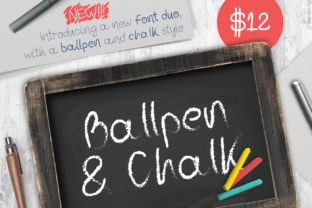
Ballpen and Chalk: A Warm, Human Script Font for Digital Branding
It started with a hero section—just two lines of text over a soft linen-textured background. I was redesigning a small creative coaching website, one where the founder’s voice is everything: thoughtful, grounded, quietly confident. The existing sans serif felt clean but distant. I needed something that whispered “handwritten note from a trusted friend,” not “corporate template.” That’s when I dropped Ballpen and Chalk into the headline field—and instantly paused.
Ballpen and Chalk is a script font from the Script Amp collection, designed to feel authentically tactile—not overly ornate, not cartoonish, just gently imperfect. It’s a single-weight typeface, but that simplicity works in its favor: every lowercase ‘a’, ‘g’, and ‘y’ has subtle chalky texture and slight variation in stroke thickness, like ink catching on paper grain. Uppercase letters hold presence without shouting; lowercase flows with relaxed rhythm. It’s not a calligraphy font—it’s a human script font, calibrated for digital clarity without sacrificing warmth.
I tested it first in the hero headline: “Clarity starts with one honest conversation.” At 48px on desktop, it held weight and legibility. On mobile? At 32px, it stayed readable—but only with generous letter-spacing (+0.05em) and a light background overlay (10% black at 70% opacity) to ensure contrast. Ballpen and Chalk isn’t built for dense paragraphs or tiny interface labels. It’s a display font, purpose-built for moments that need emotional resonance: headlines, section titles, CTA banners, testimonial quotes, course module names, and short brand statements.
Where it shines most is in context that values authenticity over polish. Think of a boutique online store selling handmade ceramics—their “New Arrivals” banner gains quiet confidence with Ballpen and Chalk above a neutral product grid. Or a portfolio site for a textile artist: using it for project titles (“Indigo Dye Journal”, “Linen & Light”) adds narrative texture without competing with imagery. On a course sales page, pairing it with a crisp, airy sans serif like Inter or Manrope creates instant visual hierarchy—Ballpen and Chalk carries the voice; the sans carries the information.
Readability depends entirely on placement and pairing. Over high-contrast backgrounds (white text on deep charcoal), it performs beautifully—even at smaller sizes like 24px for subheadings. But on busy image overlays? I added a subtle semi-transparent background behind each line of text. On dark mode interfaces, I swapped to a slightly lighter weight version (when available) or adjusted tracking to prevent visual crowding. And yes—I checked: Ballpen and Chalk includes full basic Latin characters (A–Z, a–z, 0–9, common punctuation), but no extended diacritics or multilingual glyphs. For English-first digital brands, it’s complete. For global-facing sites needing accented characters, verify coverage before committing.
Font pairing is where Ballpen and Chalk reveals its versatility. As a script font, it pairs best with typefaces that don’t compete for attention. I used it with Inter (a highly legible, open-source sans serif) for body copy and navigation—clean contrast without visual tension. For a more editorial tone, IBM Plex Serif offered gentle gravitas in blog headers while letting Ballpen and Chalk anchor key pull quotes. Avoid pairing it with other scripts or decorative fonts—two personalities in one layout dilute intention. One human voice per moment is enough.
In practice, I used Ballpen and Chalk across four key areas of the coaching site:
- Hero headline — Largest size, centered, with ample vertical space
- Section dividers — “What You’ll Gain”, “How It Works”, styled at 36px with tighter line-height
- CTA buttons — Only on primary action buttons (“Start Your Session”), never on secondary links
- Testimonial attributions — Small caps + light weight for names, adding quiet credibility
It didn’t work everywhere—and that’s the point. I skipped it for form labels, pricing tables, and footer links. Ballpen and Chalk earns its place by being intentional, not ubiquitous. Its strength lies in scarcity: a deliberate pause in the scroll, a visual inhale before the content begins. That’s how it builds trust—not through authority, but through approachability.
Before deploying, I confirmed webfont availability: Ballpen and Chalk ships as WOFF2 (ideal for fast loading), with straightforward CSS @font-face declarations. No complex variable axes or obscure file formats—just clean, lightweight delivery. Licensing is clear: commercial use included, no monthly subscription, no attribution required. For designers embedding fonts into client sites, templates, or digital brand kits, that predictability matters. No surprises at handoff.
One last note on mood: Ballpen and Chalk doesn’t evoke luxury or tech-forward energy. It evokes sincerity. It suits brands rooted in craft, care, mentorship, slow creativity, or mindful service. If your digital identity leans into warmth over wow, restraint over flash, and resonance over reach—this script font feels less like a design choice and more like a natural extension of voice.
So yes—I kept it in the hero. Not because it looked “pretty,” but because it made the first sentence land like a real conversation—not a conversion funnel. And in a web landscape saturated with algorithm-optimized sameness, that kind of human connection still loads fastest of all.