Artisoya: A Thoughtful Script Font for Warm, Human Branding
It was 10:47 a.m. on a Tuesday — coffee lukewarm, brand board half-built, and a new client’s handmade skincare line staring back at me. They’d asked for something “soft but intentional, personal but polished.” Not “cute.” Not “corporate.” Just… real. I opened my font library, scrolled past the usual suspects, and landed on Artisoya. Not because it was trending, but because its name quietly suggested artistry and soy — earthy, gentle, grounded. I typed “Luna Botanica” in it, adjusted tracking to –20, and paused. It didn’t shout. It leaned in.
A Script That Breathes
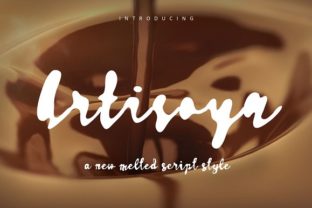
Artisoya is a script font from Darwinoo, part of their Script Amp collection — meaning it’s designed with expressive amplitude: subtle bounce, graceful entry/exit strokes, and a rhythm that feels handwritten without sacrificing polish. It’s not a wild brush script or a tight calligraphic face. Instead, it lands somewhere between refined ink and relaxed pencil — slightly tapered terminals, modest contrast, and just enough variation in stroke weight to feel alive. There are no aggressive swashes or overwrought ligatures. What you get is clean elegance with warmth baked in.
I tested it across touchpoints: a logo lockup (with a simple sans-serif secondary), a product label mockup for a lavender-honey serum, Instagram story banners, and even a printed business card. On packaging, Artisoya held up beautifully at 14–18 pt — legible, distinctive, and tactile-feeling. The lowercase g and y have soft, open descenders that add quiet personality without clutter. Uppercase letters maintain presence without stiffness — especially the S, C, and A, which anchor phrases with gentle authority.
Where It Shines (and Where It Steps Back)
Artisoya excels as a logo font and display typeface — ideal for names, taglines, headers, and short product descriptors. In the skincare project, it worked perfectly for “Small-Batch • Plant-Centered • Made Here” on a kraft paper label. It gave warmth where sterile sans-serifs would’ve felt clinical, and restraint where bolder scripts might’ve overwhelmed the minimalist aesthetic.
On the web? It performed well in hero sections and social graphics — especially when exported as a lightweight WOFF2 and paired with a neutral, highly readable sans-serif like Inter or Work Sans for body copy. But I wouldn’t use it below 20 px on screen, and never for paragraphs or navigation menus. Its charm lives in brevity and intention.
For print, it translated cleanly to uncoated stock — no ink spread or loss of detail. On a café menu mockup (a side test), it added texture without competing with food photography. But I’d avoid it for signage over 15 feet — the subtlety blurs at distance. And while it’s lovely on a wedding invitation or ceramic mug, it’s not built for legal disclaimers, technical documentation, or enterprise dashboards.
Pairing With Purpose
Artisoya pairs naturally with typefaces that offer structure without coldness. I landed on IBM Plex Serif for editorial layouts — its gentle serifs echo Artisoya’s organic flow, and its generous x-height keeps hierarchy clear. For digital interfaces, Manrope (a friendly, open sans) balanced Artisoya’s fluidity with crisp functionality. Avoid pairing it with other scripts — unless you’re intentionally building a layered typographic system with clear roles (e.g., Artisoya for brand name, a delicate monoline script only for icons or flourishes).
The font includes one weight — regular — plus a set of stylistic alternates (including a slightly more upright ‘a’, a connected ‘f-l’ ligature, and alternate ‘t’ and ‘e’ forms). No bold or italic variants — which is fine, because Artisoya isn’t meant to carry typographic weight. It’s an accent, not the engine. Darwinoo delivers it in OTF and WOFF2 formats, with solid Latin-1 support. No extended Cyrillic or Arabic coverage — so keep that in mind for multilingual projects.
Testing Before Committing
Before locking Artisoya into final files, I always do three quick checks: First, I paste the full client name + tagline into a mockup at actual size — on both screen and print. Does it feel *speakable*? Second, I convert it to outlines and zoom to 400% — any awkward joins or inconsistent spacing becomes obvious fast. Third, I export a PNG and send it to a colleague who hasn’t seen the project — does it land with the right tone? With Artisoya, the answer was consistently “yes,” but only when used sparingly and with breathing room.
Also worth noting: Artisoya is a commercial font. If you’re using it for client work — especially for packaging, merchandise, or web fonts served to thousands — verify the license covers your use case. Darwinoo’s licensing is straightforward (desktop + web included in standard purchase), but always double-check before handing off assets.
A Font That Feels Like a Choice, Not a Trend
What makes Artisoya stand out isn’t novelty — it’s quiet confidence. It doesn’t try to be everything. It’s not trying to mimic calligraphy, nor does it chase maximalist energy. It’s a script font that respects the space around it, honors the hand behind the design, and invites the viewer in — softly. In a landscape full of high-contrast display fonts and AI-generated “handwritten” chaos, Artisoya feels like a reminder: sometimes the most powerful branding gesture is simply writing something well, with care.
If your project values sincerity over spectacle — whether it’s a ceramic studio’s logo, a local bakery’s seasonal menu, or a creative studio’s identity refresh — Artisoya won’t distract. It’ll settle in, hold space, and let the brand breathe.