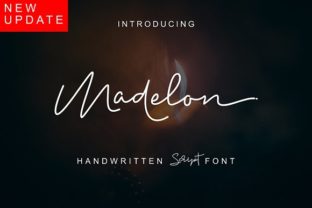
Madelon: A Fresh Thin Monoline Font for Digital Branding
It started with a hero section—just one line of text over a soft, sunlit lifestyle photo: “Your calm begins here.” I’d been cycling through fonts all morning, trying to land on something that felt intentional but never stiff, elegant but never fussy. Then I loaded Madelon. Instantly, the layout exhaled. Not because it was loud or attention-grabbing—but because it carried quiet confidence. That’s the magic of Madelon: it’s a fresh, thin monoline script font from Script Amp, and in real web layouts, it doesn’t shout—it invites.
What Madelon Brings to the Screen
Madelon is a modern script typeface built on clean, consistent stroke weight—no thick-and-thin contrast, no dramatic flourishes. Its monoline structure gives it subtle rhythm without sacrificing clarity, and its open letterforms breathe beautifully against both light and dark backgrounds. I tested it across devices: on desktop, it reads like a thoughtful whisper; on mobile, it holds its shape without blurring or collapsing—even at 32px on a 375px viewport. It’s not a handwriting font pretending to be spontaneous; it’s a refined display font designed for intentionality. That makes it ideal for moments where tone matters most: a boutique’s tagline, a coach’s welcome headline, or a course landing page’s core promise.
Where It Shines (and Where It Doesn’t)
In practice, Madelon excels in short, high-impact roles:
- Hero headlines — Paired with a neutral sans serif like Inter or Manrope, it creates instant hierarchy without visual noise.
- Section titles — On a portfolio homepage, “Work” or “Process” in Madelon feels personal but polished.
- CTA accents — Try “Start Your Journey” above a button—not as the button text itself, but as supporting context.
- Branded graphics — For social banners or email headers, Madelon adds warmth without compromising load speed or readability.
That said, Madelon isn’t built for long-form reading. I tested it in a blog intro paragraph—and while charming for the first sentence, it fatigued quickly. It’s also too delicate for small navigation labels, form inputs, or dense dashboard interfaces. And while it performs well on light and dark modes, avoid placing it directly over busy image overlays without sufficient contrast padding or a subtle text shadow.
Real Layout Testing: From Mockup to Live Site
I dropped Madelon into three live contexts: a coaching website’s homepage, a digital product launch landing page, and a small-biz blog header redesign. In each case, I paired it with Inter (variable weight, open source, excellent web performance) for body copy and UI elements. The contrast worked beautifully—Madelon brought voice; Inter brought function. On the coaching site, “Clarity starts with one conversation” in Madelon anchored the hero, then faded gracefully into Inter for the subhead and CTA. No font swapping, no layout shift—just smooth, human-centered typography.
For the product launch, I used Madelon only for the headline and the feature list icons’ short descriptors (“Gentle on your time,” “Designed for focus”). It reinforced brand personality without competing with functionality. And on the blog? Swapping the default serif header for Madelon instantly softened the tone—making technical content feel more approachable, not less credible.
Practical Considerations for Web Designers
Before dropping Madelon into your next project, check a few things:
- Webfont support: Confirm the package includes WOFF2 files—they’re lean, widely supported, and critical for fast loading.
- Licensing: Script Amp fonts are commercial-ready, but always verify usage rights for client sites, SaaS dashboards, or embedded widgets.
- Weights & alternates: Madelon is a single-weight display font—no bold or italic variants. That’s by design, but plan accordingly. If you need emphasis, rely on size, color, or spacing—not weight shifts.
- Language coverage: It supports Latin-based languages well (English, Spanish, French, German), but double-check diacritics if targeting broader European or multilingual audiences.
Also worth noting: Madelon’s letter spacing benefits from slight manual adjustment in CSS (letter-spacing: .03em) for optimal rhythm at larger sizes—especially on high-DPI screens.
Pairing With Purpose
Font pairing isn’t about aesthetics alone—it’s about assigning roles. Madelon thrives when paired with a highly legible, low-contrast sans serif: Inter, Poppins, or even system fonts like -apple-system for maximum performance. Avoid pairing it with other scripts or decorative fonts—that dilutes its quiet strength. If your brand leans editorial (think newsletters or long-form content), consider a gentle serif like Lora or Cormorant Garamond for body copy—but keep Madelon strictly for top-of-funnel moments.
One final note: Madelon doesn’t try to do everything. It doesn’t replace your system font. It doesn’t solve poor layout or weak messaging. But when used with care—in the right place, at the right size, with the right contrast—it elevates digital presence with remarkable economy. It’s the kind of font that makes visitors pause, not because it’s flashy, but because it feels like it belongs—like the design finally remembered to take a breath.