Kanda: A Friendly Handwritten Sans Serif Font for Digital Design
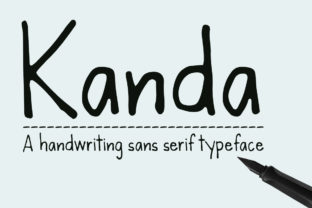
As a web and UI designer who ships dozens of landing pages, SaaS dashboards, and e-commerce experiences each year, I’ve learned that typography isn’t just about aesthetics—it’s about behavior. How users scan, pause, trust, and act is shaped by the typeface in front of them. That’s why Kanda stands out: it’s a rare hybrid—a sans serif handwritten font drawn with a fountain pen, yet engineered for clarity on screens. It’s not a chaotic script or a sterile system font. It’s relaxed but legible, personal but professional.
Kanda lives in the Script Amp category, but don’t mistake it for a traditional script font. There are no dramatic flourishes or forced connections between letters. Instead, its strokes carry subtle ink variation, soft terminals, and gentle rhythm—qualities that evoke authenticity without sacrificing readability. On a mobile screen at 24px, Kanda remains crisp. At 48px in a hero section, it feels warm and human—not stiff, not gimmicky. That balance makes it ideal for digital products where tone and usability must coexist.
In practice, I reach for Kanda when the brand voice needs approachability without informality. Think of a wellness coach’s landing page: the headline “Your First Step Starts Here” in Kanda over a soft gradient reads as inviting—not salesy. Or a boutique online store using Kanda for product category banners (“Hand-Poured Candles”, “Small-Batch Soaps”)—it adds craft and care without overwhelming the layout. It works especially well in conversion-focused areas: CTA buttons (“Join the Waitlist”), testimonial quotes, email header graphics, and course enrollment sections where emotional resonance supports action.
But Kanda isn’t meant for body text—and that’s intentional. Its strength lies in visual hierarchy. Use it for primary headings, short section titles, logo lockups (when paired with clean supporting type), and branded accent elements like divider lines or quote marks. Avoid long paragraphs, dense feature lists, or navigation menus. For those, pair Kanda with a neutral sans serif like Inter, Poppins, or even a gentle serif like Cormorant Garamond—depending on whether your brand leans modern-minimal or editorial-refined. That contrast creates breathing room and guides attention precisely where you need it.
On responsive layouts, Kanda scales gracefully. At smaller sizes (16–20px), it shines in mobile navigation bars or inline highlights—just ensure sufficient letter spacing and contrast. Over dark backgrounds, use a light or medium weight with subtle text shadow or increased tracking. Over imagery, apply a soft semi-transparent overlay or set Kanda at 85% opacity to preserve legibility while keeping its organic texture intact. Test on real devices: its open counters and generous x-height hold up well on OLED screens and mid-tier Android displays alike.
For brand consistency, Kanda delivers across touchpoints. Use it identically in Figma design files, CSS @font-face declarations, and social media graphics—no visual drift. The font family includes multiple weights (Light, Regular, Medium) and supports Latin-based languages, including extended diacritics for European markets. If your project targets multilingual audiences, verify that the package includes full OpenType features and proper Unicode coverage before licensing.
Licensing is straightforward but critical. As a commercial font from Script Amp, Kanda requires a web license for live sites—even if embedded via Google Fonts or self-hosted. That license covers usage across client websites, SaaS platforms, online stores (Shopify, WooCommerce), and digital templates sold on marketplaces. It does not extend to desktop-only use or redistribution in editable design assets unless explicitly permitted. Always confirm the license tier matches your deployment scope—especially for agencies shipping white-labeled dashboards or subscription-based tools.
I’ve used Kanda in contexts where tone directly impacts conversion: a mental health app’s onboarding flow (Kanda for step headers, Inter for instructions), a creative portfolio site’s project titles (paired with monospace code fonts for tech context), and a premium newsletter’s banner graphic (“New Issue: Clarity in Chaos”). In each case, Kanda helped signal intention—thoughtful, human-centered, unhurried—without slowing down comprehension.
It also avoids common pitfalls of decorative fonts. No awkward kerning traps. No inconsistent baseline alignment. No fragile ligatures that break in CMS editors. And because it’s built as a sans serif—despite its handwritten soul—it aligns predictably with grid systems and flexbox layouts. You won’t fight vertical rhythm or overflow issues in constrained containers like cards or notification badges.
For designers building brand identity systems, Kanda serves as a strong anchor for the “personality layer” of typography. Pair it with a functional, highly legible sans for UI components and a refined serif for long-form content—and you’ve got a triad that supports both emotion and efficiency. It’s especially effective for brands in coaching, creative services, sustainable goods, education, and lifestyle sectors, where warmth and credibility must coexist.
If you’re evaluating Kanda for your next project, ask: Does this headline need to feel like a conversation—or a command? Does this button need to invite—or instruct? Does this brand need distinction without distance? When the answer leans toward human, grounded, and quietly confident, Kanda earns its place—not as decoration, but as deliberate design infrastructure.