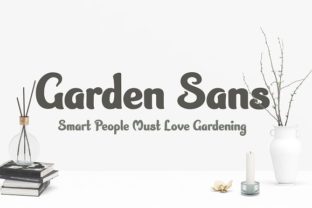
Garden Sans: A Bold, Rounded Display Font for Friendly Branding
It was 10:47 a.m. on a Tuesday—coffee lukewarm, brand board half-built—and I dropped Garden Sans onto a café’s logo draft just to see what happened. Not as a final pick, not even as a top contender. Just curiosity. Within five minutes, it had already reshaped the whole mood of the project: warmer, more approachable, quietly confident. That’s when I knew this wasn’t just another rounded sans.
A Typeface That Feels Like a Handshake
Garden Sans is a bold, rounded semi-sans serif—designed by Darwinoo and released through Script Amp. It sits comfortably between friendly and focused: soft curves without being cutesy, sturdy weight without feeling heavy, and that subtle semi-serif flare at terminals that adds just enough character to avoid generic territory. It’s not a full script font, but it carries script-like warmth in its rhythm and spacing. The 370+ glyphs include smart alternates, stylistic sets, and extended Latin support—enough to handle most English-language branding needs, plus common European accents and punctuation variants you’ll actually use.
What stood out immediately in testing was how well it holds presence at small sizes *on packaging*. I mocked it up on a ceramic mug label (12 pt), a kraft paper tea box (10 pt), and a matte-finish business card (9 pt). Unlike many display fonts that vanish or blur below 14 pt, Garden Sans kept its shape and legibility—thanks to generous x-height, open counters, and deliberate letter-spacing built into the design. It doesn’t try to be body text, but it *works* where display fonts often fail: on physical touchpoints with tight space constraints.
Where It Shines (and Where It Doesn’t)
In logo design? Excellent—if your brand leans artisanal, local, or human-centered. I used it for a handmade soap line’s wordmark, and the rounded terminals softened the “clean lab” vibe while keeping things professional. Paired with a quiet serif like Lora or EB Garamond for body copy, it created instant visual hierarchy: Garden Sans said “this is who we are,” and the serif said “here’s what we do.”
For web headers and social media graphics? Strong. It loads cleanly as a webfont (WOFF2 included), and its bold weight reads clearly against textured backgrounds—especially on Instagram carousels or Pinterest pins where contrast matters more than fine detail. On a homepage hero section, it held attention without shouting. On a printed poster? Even better—the ink spread slightly on uncoated stock, and Garden Sans’s robust forms absorbed it gracefully.
But let’s be real: it’s not for everything. Don’t use it for long-form editorial content, legal disclaimers, or corporate annual reports. Its personality is too distinct for neutral contexts. And while it’s highly legible at 14–24 pt, pushing it below 8 pt—even with tight tracking—starts to erode clarity, especially in all-caps settings. It’s not a system font; it’s a voice font.
Smart Pairing, Not Just Pretty Pairing
Garden Sans thrives when paired intentionally—not just “what looks nice,” but what serves the brand’s function. With a warm, low-contrast serif (think Playfair Display or Cormorant Garamond), it balances tradition and freshness. Against a clean, geometric sans like Inter or Manrope, it becomes the expressive anchor in an otherwise functional system. I avoided pairing it with other rounded fonts—too much harmony kills contrast—and skipped script fonts unless they were extremely restrained (e.g., a single-line monoline script for a tagline accent).
The key is role clarity: Garden Sans leads. Everything else supports. In my café project, it handled the shop name, menu headers, and chalkboard-style specials. A lightweight sans took care of hours, ingredients, and fine print. No competition. Just conversation.
Before You License It—A Quick Reality Check
Garden Sans is a commercial font, and Darwinoo’s license (via Script Amp) covers standard desktop, web, and app use—but double-check before applying it to merchandise, templates, or digital products you plan to resell. I always test licensing scope early: if the client plans to put the logo on tote bags, mugs, and Shopify banners, confirm the license includes those uses. Some vendors require extended licenses for product labeling or SaaS interfaces. Better to verify than revise later.
Also—test it in context before committing. Drop it into your actual Figma file, not just a font preview. Try it on a mockup with real photography, real color palettes, real textures. See how it behaves next to your brand’s primary color at 70% opacity. Try it in all-caps on a dark background. Try it in sentence case over a busy pattern. Garden Sans is forgiving, but it’s not magic. Its strength lies in intention—not autopilot.
At the end of the day, Garden Sans isn’t trying to be everything. It’s a focused tool: a bold, rounded display font for brands that want to feel grounded, kind, and quietly confident. It won’t solve weak strategy or poor color choices—but in the right hands, on the right project, it adds warmth without sacrificing polish. And sometimes, that’s exactly what a brand needs to say hello.