Harley Q: A Bold Display Font for Creative Digital Brands
I was finalizing the hero section of a boutique online store for an indie comic book illustrator—think hand-drawn merch, limited-edition prints, and behind-the-scenes storytelling—and needed a headline font that felt alive. Not just “cool,” but *characterful*. That’s when I dropped Harley Q into the mockup. Instantly, the headline pulsed with personality: sharp angles, uneven baseline, ink-splatter energy—like something ripped from a DC Universe sketchbook, but refined for screen.
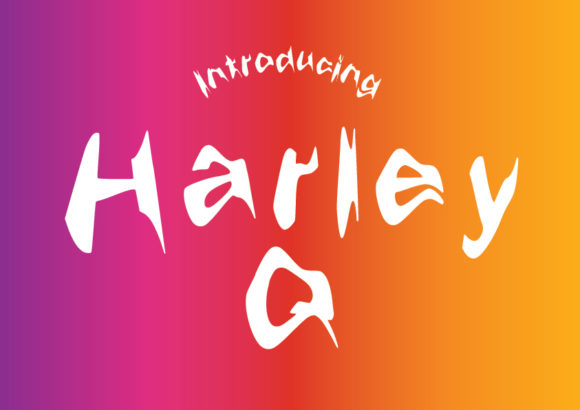
Harley Q is a premium script font from Script Amp, designed as a stylized, menacing-yet-playful interpretation of Harley Quinn’s handwriting. It’s not a casual brush script—it’s a tightly crafted display typeface with deliberate irregularity: exaggerated ascenders, abrupt terminals, and subtle comic-book texture baked into the outlines. Visually, it lands somewhere between editorial illustration and digital branding—bold enough for banners, expressive enough for logos, but never chaotic.
In practice, I used Harley Q for three key elements on that store homepage: the main headline (“New Sketch Series Live”), the “Add to Cart” button label, and the small tagline beneath the product carousel (“Drawn by hand. Digitally loved.”). Each use served a different purpose—and revealed something about how this font behaves in real web layouts.
For the hero headline, Harley Q shined at 48px on desktop and scaled cleanly down to 36px on tablet. On mobile, I switched to a tighter line-height and added slight letter-spacing to preserve legibility without sacrificing attitude. It held up well over a dark image overlay—no stroke or shadow needed—thanks to its high contrast and confident weight. But here’s what I learned: Harley Q isn’t built for paragraphs. It’s a display font, first and foremost. I paired it with Inter for body copy and navigation—clean, neutral, highly readable sans serif—and the contrast elevated both fonts. The pairing felt intentional, not forced: one voice shouts the vibe, the other quietly guides the user.
On buttons, Harley Q added instant recognition—but only for primary CTAs with short text. “Shop Now” worked beautifully. “View Full Collection & Pricing Details” did not. For anything longer than four words, I reverted to Inter. That’s not a limitation—it’s smart typography discipline. Display fonts like Harley Q thrive in moments of emphasis, not endurance.
I also tested it in a blog header redesign for a freelance character designer. There, Harley Q anchored the site identity: used in the logo lockup (with a simplified version of the “H” as a standalone icon), in post category badges (“Fan Art,” “Process Breakdown”), and as decorative accents in newsletter headers. In each case, I kept usage sparse and purposeful—never more than one instance per visible screen area. Overuse diluted its impact; restraint made it memorable.
Readability testing across devices confirmed what the design hinted at: Harley Q performs best at larger sizes, on light or mid-tone backgrounds, and with generous spacing. On dark mode, it remained clear—but I avoided using it over busy image textures or low-contrast gradients. For fast-loading pages, I loaded it as a single WOFF2 file (included in the Script Amp package) and declared it with @font-face using font-display: swap. No FOIT, no invisible text—just smooth, confident loading.
Licensing was straightforward: Script Amp offers commercial web licenses with unlimited domains and projects, including SaaS dashboards and client sites. No hidden tiers. The package includes one weight (Bold), but it ships with stylistic alternates—swash capitals, alternate “Q” and “H” glyphs, and ligatures—that add nuance when manually applied via CSS font-feature-settings. I used the alternate “Q” in the logo and the swash “H” in the footer tagline. Small touches—but they made the brand feel hand-tuned, not templated.
What surprised me most was how Harley Q affected perceived trust—not in a corporate sense, but in a creative one. On the coaching website I audited last month (a narrative-driven brand strategy service), the founder initially wanted something “friendly and approachable.” We tried softer scripts—but they felt generic. When we swapped in Harley Q for the headline “Your Story, Strategically Told,” the tone shifted: confident, human, slightly rebellious. Clients responded to that authenticity. It didn’t make the site “more professional” in a traditional sense—but it made the brand feel *more real*.
That’s Harley Q’s strength: it doesn’t blend in. It invites attention, then earns it through consistency and care. Use it for hero titles where you want emotional resonance. Use it for section headers that introduce a new chapter—like “Behind the Panels” on a portfolio site or “Unlocked Skills” on a course landing page. Avoid it for form labels, pricing tables, or legal footers. And always pair it thoughtfully: a strong serif like Playfair Display for editorial depth, or a geometric sans like Manrope for modern clarity.
Before deploying, I checked multilingual support—Harley Q covers Latin Extended-A, so it handles accented characters common in European languages, but stops short of Cyrillic or Greek. For global-facing projects, I noted that in the font stack fallback. Also worth mentioning: while it’s not a variable font, its single-weight precision makes it lightweight and predictable in responsive contexts—no rendering hiccups on older iOS versions or budget Android devices.
Ultimately, Harley Q isn’t about mimicking a comic book—it’s about borrowing its confidence. It works because it respects the craft behind both typography and digital experience. You don’t choose it to be trendy. You choose it when your brand has something unmistakable to say—and wants the typeface to say it with teeth.