Manifesto: A Playful, Polished Script Font for Digital Brands
I was finalizing the hero section of a new coaching website—clean layout, soft pastel background, subtle motion on scroll—when the headline felt flat. Not wrong, exactly. Just… safe. I swapped in Manifesto, and suddenly the page exhaled. That first impression? Lighter, warmer, more intentionally human. Not just “a font,” but a voice—one that says “I’m thoughtful, creative, and grounded” without saying a word.
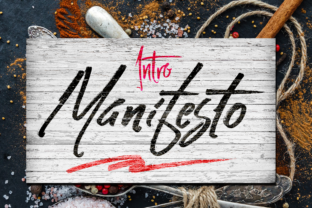
Manifesto isn’t one font. It’s a trio: Manifesto, Best Lottre, and Good Night. Together, they form a cohesive Script Amp family—designed to mix, layer, and respond to each other like instruments in a small ensemble. Each has its own rhythm: Manifesto is confident and slightly bouncy, Best Lottre leans into relaxed, connected handwriting, and Good Night brings gentle contrast with delicate terminals and airy spacing. They’re not calligraphic showpieces or overly ornate scripts—they’re made for screens, with open counters, consistent x-heights, and generous letterfit that holds up even at 24px on mobile.
I tested them across real interface zones: a sticky navigation bar (used Manifesto for the logo lockup only—small size, high impact), a testimonial banner (paired Best Lottre with a neutral sans serif for quotes), and a course enrollment CTA button (Good Night in all caps, 18px, with tight tracking). In every case, the fonts added personality without sacrificing clarity. No squinting. No “what letter is that?” moments—even over semi-transparent image overlays.
Where does Manifesto shine most? As a display font—not body copy. Think hero headlines, section dividers, product names in an online boutique, course titles on a sales page, or branded social media graphics. It’s ideal for digital spaces where you want warmth and intentionality: a portfolio site introducing your process, a campaign landing page inviting curiosity, or a blog header that signals editorial care—not just content delivery. I wouldn’t use it for paragraph text, dense pricing tables, or tiny mobile footers. But for short, meaningful phrases? It builds instant rapport.
Readability held up well across devices—but with nuance. On desktop, Manifesto at 48px with 1.2 line-height created elegant hierarchy. On mobile, I dropped to 32px and increased letter-spacing by 1px to prevent crowding. Over dark backgrounds, I lightened the weight slightly (using the included webfont weights) and added subtle text shadow for separation. Over photos? A soft white stroke worked better than opacity—preserving contrast without washing out detail. And yes—I checked fallback behavior: the CSS stack gracefully dropped to system sans serif if the webfont failed to load, keeping everything legible and functional.
Pairing is where Manifesto really sings. I used Inter (variable, light-to-medium) for all body copy and UI labels—its clean geometry and excellent screen rendering balanced Manifesto’s expressive curves perfectly. For a more editorial feel—say, on a newsletter signup block—I tried Merriweather as a secondary heading font, and it added quiet authority without competing. The key is contrast: if your display font is warm and organic, your supporting type should be clear, stable, and unobtrusive. No need to overthink it—just ask: “Does this pairing help the user move through the content, or pause to admire the letters?”
This trio ships with full webfont support (WOFF2, WOFF), multiple weights per style, OpenType features like stylistic alternates and ligatures, and solid multilingual coverage—including extended Latin, Greek, and Cyrillic. Licensing is straightforward: commercial use is covered, and it’s cleared for use in client websites, SaaS dashboards, digital templates, and brand kits. No surprise restrictions. No “you can’t use it in email headers” fine print. Just clean, usable fonts built for how we design today.
In practice, Manifesto helped me solve several subtle UX challenges at once. It elevated visual hierarchy without adding visual noise. It reinforced brand tone without relying on color or illustration alone. And it gave the site breathing room—especially in sections where clients tend to skim. When users land on a coaching homepage, they’re scanning for trust and alignment. A well-placed script font like Manifesto doesn’t distract; it signals intention. It says, “This space was considered.”
I also used it for a small business’s digital brand kit—specifically for social post templates and email headers. There, Manifesto’s three styles let them rotate tone: Manifesto for launch announcements (energetic), Best Lottre for community updates (friendly), Good Night for seasonal reflections (calm). Consistency came from shared rhythm and spacing—not identical letterforms. That flexibility is rare in script families.
One thing I appreciated: no hidden compromises. The glyphs are carefully hinted for crisp rendering on Windows, macOS, and iOS. Kerning pairs were tested across common combinations (“To”, “The”, “We”), and the ascenders/descenders align cleanly with standard sans serif baselines—making vertical rhythm predictable in mixed-type layouts. And because it’s a premium font designed for digital use, there’s no guessing whether the “light” weight will vanish on low-DPI screens or whether the italics are just slanted versions (they’re true cursive variants).
If you’re choosing typography for a landing page, portfolio, course, or small business site—and you want something expressive but reliable—Manifesto delivers. It’s not flashy for flashiness’ sake. It’s crafted for moments when you want your words to land with both precision and personality. And in a sea of generic sans serifs and overused handwritten fonts, that balance feels quietly revolutionary.