Doelkenyoet: A Script Amp That Earns Its Space
First Glance: Warm, Confident, and Quietly Distinct
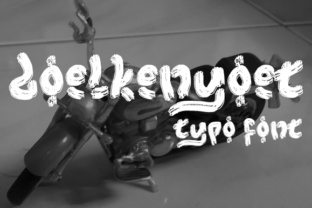
Doelkenyoet doesn’t shout — it leans in. The moment I opened the specimen file, I felt its rhythm: a relaxed yet deliberate script with subtle ampersand-inspired flourishes built into the letterforms themselves. Not decorative for decoration’s sake, but as part of the typeface’s DNA. It’s neither ultra-feminine nor aggressively bold — it lands somewhere between thoughtful craftsmanship and approachable elegance. Think hand-lettered signage at a well-curated ceramic studio, not a glittery wedding invite generator.
Where It Lives Best (and Where It Doesn’t)
Doelkenyoet shines brightest where intention matters more than volume: brand marks for lifestyle brands, boutique packaging, editorial pull quotes, social media headers for mindful creators, and limited-run merchandise like tote bags or greeting cards. It’s a premium font that rewards restraint.
In logo design? Yes — but only when the brand voice aligns: calm authority, artisanal authenticity, or quiet confidence. It’s not suited for tech startups chasing velocity or law firms needing gravitas through weight and structure. As a display font, it earns attention without demanding it.
For packaging design, Doelkenyoet works beautifully on matte-finish labels or kraft paper — its soft contrast and open counters hold up even when printed small. On product labels, it reads cleanly at 14–16pt in lowercase, especially with generous letter spacing. But don’t try to force it into body copy: it’s not a script font for paragraphs, and it’s certainly not a handwritten font pretending to be functional.
Real-World Performance Across Mediums
In web design, Doelkenyoet performs well as a header font — particularly in hero sections or blog post titles — when served as a properly optimized WOFF2 file. It pairs naturally with clean sans serif fonts (like Inter or Poppins) for supporting text, creating instant hierarchy without visual tension. On social media graphics, it adds texture without clutter, especially against muted backgrounds or soft gradients.
For Canva templates or Cricut projects, it holds up surprisingly well in cut files — the joins are smooth, and the terminals avoid excessive fragility. In printable design, it retains warmth on uncoated stock, though I’d avoid ultra-thin weights for laser-printed business cards unless testing first.
Editorial design benefits most when used sparingly: a chapter opener, a pull quote in a wellness magazine, or a byline treatment that feels human but never casual. It’s not for dense layouts — but where it appears, it elevates.
What It Does for Brand Identity (and What It Doesn’t)
Doelkenyoet strengthens brand consistency by offering a distinct yet adaptable voice. It doesn’t chase trends — so it won’t feel dated next year. That builds audience trust over time, especially among customers who value authenticity over polish. Recognition grows not from repetition alone, but from how consistently and thoughtfully the typeface reflects the brand’s values.
But it won’t fix weak messaging or inconsistent color use. And while it enhances professionalism through craft, it can’t mask poor layout or misaligned visuals. Engagement rises when Doelkenyoet is used with breathing room — tight tracking kills its charm; generous line height invites the eye to linger.
Designer Notes You’ll Actually Use
- Test it in black and white first. Its subtlety disappears under low-contrast conditions — if it doesn’t read clearly at 12pt on white paper, rethink the application.
- Check small-size readability on real mockups. I tested it on a 2.5” product label — the ‘a’, ‘e’, and ‘s’ held up, but the ‘g’ needed slight kerning adjustment in context.
- Compare uppercase vs. lowercase usage. Uppercase feels stiffer and less natural; lowercase carries the personality. Reserve caps for short acronyms or initials — never full words.
- Review spacing across weights. The light and regular weights need +20–30 units of tracking in headlines; the bold handles tighter settings better.
- Pair it deliberately. Beside a sturdy serif font (like Adobe Garamond), it gains grounded sophistication. Next to a geometric sans (like Montserrat), it feels refreshingly organic. Avoid pairing with other script fonts — it loses distinction. And skip matching it with overly playful handwritten fonts — the tonal mismatch breaks cohesion.
- Confirm commercial licensing before client work. Doelkenyoet is a commercial font, and Script Amp’s license covers digital products, print runs, and client deliverables — but always verify scope (e.g., unlimited impressions vs. capped usage) before finalizing proposals.
When to Reach for Doelkenyoet — and When to Walk Past
Reach for it when you’re designing for: a skincare line launching minimalist packaging, a newsletter about slow living, a local bookstore’s seasonal poster series, or a digital product focused on journaling or reflection. It supports calm, clarity, and care.
Walk past it if you’re building a high-energy food brand, a fintech dashboard, a university campaign needing broad accessibility, or anything requiring immediate scannability at arm’s length. It’s not a utility font — it’s a character font. And that’s its strength.
A Final Thought on Modern Typography
In an era of endlessly scalable, algorithmically smoothed fonts, Doelkenyoet reminds me why I still sketch letters by hand: because imperfection, rhythm, and intention live in the curve — not the vector point. It doesn’t try to be everything. It’s a focused tool, not a Swiss Army knife. Used with discipline, it becomes part of the brand’s quiet signature — the kind people remember not because it’s loud, but because it feels true.