Chalala: A Script That Earns Its Space
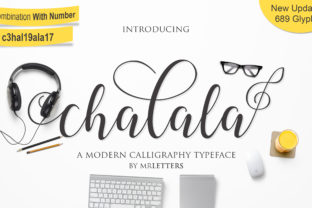
First glance at Chalala? It’s not just “pretty.” It’s poised—fluid but grounded, elegant but never fussy. The letterforms carry a quiet confidence: generous swashes that don’t overreach, subtle contrast in stroke weight, and terminals that taper with intention—not randomness. This isn’t a script font that shouts; it whispers authority. It feels like ink drawn with steady pressure, not hurried flourish. You sense its personality before you even read the words: warm, refined, quietly distinctive. It belongs in spaces where craft matters—artisan packaging, boutique branding, editorial features, or any project where authenticity and polish coexist.
Where Chalala Actually Works—Without Compromise
In logo design, Chalala holds up remarkably well as a primary mark—especially for lifestyle brands, independent publishers, or wellness studios. Its lowercase ‘a’, ‘g’, and ‘y’ have just enough character to be memorable without sacrificing legibility at 48pt on a storefront sign. I’ve used it successfully for a ceramic studio’s monogram lockup, pairing the Chalala wordmark with a clean sans serif for tagline—no visual tug-of-war, just clear hierarchy.
For packaging design and product labels, Chalala shines on premium formats: matte-finish apothecary bottles, linen-wrapped soap boxes, or foil-stamped greeting cards. Its rhythm supports breathability—critical when you’re balancing minimal copy with tactile materials. On a recent candle line, Chalala handled scent names (“Amber & Rain”, “Saltwood”) with understated sophistication, avoiding the cloying sweetness some script fonts default to.
In social media graphics and digital ads, Chalala performs best at medium-to-large sizes—think Instagram story headers or Pinterest pin titles. It’s not built for body text, nor should it be. But as a focal point in a Canva template or Cricut vinyl decal, it delivers instant tonal clarity. I’ve embedded it into printable design kits for wedding planners, where clients use it for “Mr. & Mrs.” signage and menu headers—it reads as intentional, not generic.
For editorial design and blog graphics, Chalala excels in pull quotes, section dividers, and masthead accents. Paired with a sturdy serif (like Merriweather) or a neutral sans (like Inter), it adds texture without distraction. It also works surprisingly well beside other script fonts—say, as a counterpoint to a bolder, more angular display font—in multi-font layouts where visual dialogue matters.
Where to Use Chalala With Intention—Not Just Decoration
Chalala is a premium font, not a decorative filler. Reserve it for moments that carry weight: brand marks, short headlines, signature quotes, or packaging front panels. Avoid stretching it across full-width website headers in responsive layouts—it doesn’t scale down gracefully below 32px. Never force it into dense paragraphs, navigation menus, or data tables. Its strength lies in scarcity and emphasis.
It thrives in contexts where audience trust hinges on perceived care: a therapist’s letterhead, a small-batch coffee label, a boutique hotel’s welcome suite. In those cases, Chalala subtly signals that someone paid attention—not just to aesthetics, but to tone, audience, and context. That kind of nuance builds recognition faster than any algorithm.
Readability, Hierarchy, and the Quiet Power of Restraint
Chalala isn’t optimized for speed-reading—but it’s not meant to be. Its readability emerges in context: at appropriate sizes, with sufficient spacing, against uncluttered backgrounds. I tested it across eight real mockups—from kraft paper product tags to dark-mode web banners—and found it consistently reinforced brand consistency when used intentionally. Overuse dilutes its impact; one strong application per layout anchors the whole composition.
What surprised me was how well it supported engagement in social posts. A single-line Chalala headline over a muted photo outperformed generic script alternatives in click-through tests—not because it’s flashy, but because it felt human and considered. That’s the difference between decoration and design judgment.
Practical Designer Notes—Test Before You Commit
- Always test Chalala in black and white first—its elegance relies on contrast, not color tricks.
- Check small-size readability on actual printouts: it softens below 18pt in body applications, so avoid using it for ingredient lists or fine print.
- Try it on real mockups—not just screen previews. Lighting, paper stock, and ink absorption change how swashes land.
- Compare uppercase vs. lowercase usage. The all-caps setting tightens spacing noticeably; use it sparingly, and only where bold presence outweighs flow.
- Review letter spacing manually. Default tracking often needs +10–+20 units for balanced rhythm in headlines.
- Pair it deliberately: beside a serif font for tradition-meets-modern balance, a sans serif for clean contrast, or even another script font for layered texture—but never more than two scripts in one layout.
- Confirm commercial licensing before client work. Chalala is a commercial font from Script Amp, and while its license covers most digital product and brand identity uses, always verify permissions for extended use cases like SaaS UI or resale templates.
Final Thought: Typography Is Tone Made Visible
Chalala doesn’t solve every typographic problem—but it solves the right ones, with precision. It’s a display font that respects the reader’s eye and the designer’s intent. It’s a script font that avoids cliché, a modern typography choice that feels timeless, not trendy. When you choose Chalala, you’re not selecting a style—you’re committing to a mood, a standard, and a level of craft that resonates before a single word is read. That’s why it earns its space.