Magnificent: A Script Font That Earns Its Name
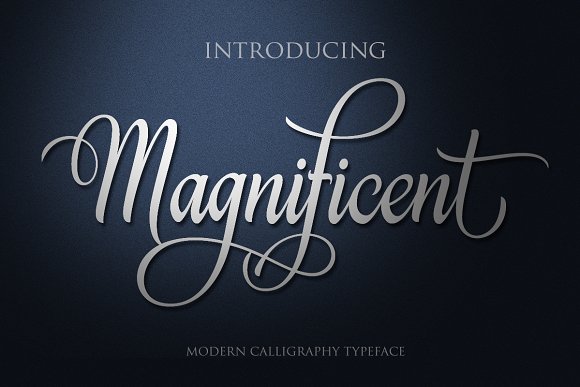
First impression? Magnificent doesn’t whisper — it leans in with quiet confidence. It’s not flashy, not fussy, and definitely not trying too hard. As a script font from Script Amp, it lands somewhere between elegant calligraphy and contemporary hand-drawn refinement: smooth entry strokes, subtle contrast in line weight, and a rhythm that feels intentional, not automated. The lowercase ‘g’, ‘y’, and ‘f’ have graceful descenders that breathe without dragging; the uppercase letters carry presence but avoid stiffness. This isn’t a wedding-invitation-only script — it’s a working script font with personality and poise.
Where Magnificent Actually Shines (and Where It Doesn’t Pretend To)
Magnificent excels where human warmth meets professional polish. In logo design, it holds its own as a primary mark for boutique brands — think ceramic studios, small-batch skincare, indie bookshops, or artisanal food labels. Its flow reads clearly at 48pt on a storefront sign and retains character even when scaled down to 24pt on a product label — provided the background contrast is strong and the surface is smooth. I’ve used it successfully for packaging design on matte-finish glass bottles and kraft paper bags, always testing print proofs first: the fine hairlines hold up well on offset but soften slightly on uncoated stock, which actually adds charm in the right context.
For social media graphics, Magnificent works best in short bursts — quote cards, launch announcements, brand story highlights. It pairs beautifully with clean sans serif fonts like Inter or Poppins for body text, creating instant hierarchy and visual trust. On websites, I reserve it strictly for headers and hero-section taglines — never for navigation or paragraph text. Its expressive nature demands breathing room, and overuse dilutes its impact. In editorial design, I’ve applied it sparingly: chapter openers, pull quotes in literary magazines, and masthead accents — never full-body copy. It’s a display font, not a workhorse.
It also translates surprisingly well into physical making. I’ve cut Magnificent cleanly on a Cricut Maker (using the OTF) for vinyl decals on tote bags and ceramic mugs — the curves stayed crisp at 1.5" height. For printable design like greeting cards or workshop handouts, it adds premium tactility, especially when printed on cotton-blend paper with subtle foil accenting. As a digital product, it enhances Canva templates aimed at creative entrepreneurs — not because it’s trendy, but because it signals craftsmanship without alienating.
The Real Talk: What Magnificent Needs From You
This isn’t a “drop-in-and-go” font. Magnificent asks for thoughtful handling — and rewards it. Its strength lies in restraint. Use it for short phrases only: brand names, taglines, headlines, quotes, and decorative accents. Avoid setting full sentences or dense paragraphs. It’s not built for long-form readability — that’s not its job. Think of it as the well-cut blazer in your type wardrobe: sharp, memorable, but worn intentionally, not constantly.
Readability is excellent at headline sizes (36pt and up) with solid contrast, but degrades quickly below 18pt — especially in all-caps or on textured backgrounds. I tested it at 14pt on a light gray background for an email header and scrapped it immediately. It lost warmth and became visually noisy. For brand consistency, stick to one weight (it’s a single-weight family) and limit color usage: black, deep charcoal, or rich navy maximize its elegance. Bright or pastel fills can flatten its dimensionality.
Audience perception shifts meaningfully with Magnificent. It communicates care, authenticity, and considered design — ideal for audiences valuing craft and intentionality. But it won’t read as bold, tech-forward, or disruptive. If your brand voice is urgent, minimalist, or highly functional (think SaaS dashboards or medical device interfaces), this isn’t your font. It builds trust through warmth, not authority — a distinction many designers overlook.
Designer Notes You’ll Actually Use
- Always test in black and white first. Color can mask spacing issues — Magnificent’s letterfit is tight in places (look at ‘To’, ‘We’, ‘The’) and benefits from manual kerning in logo lockups.
- Check small-size readability on real mockups — not just screen previews. Print a business card at actual size. View a social post on mobile in natural light.
- Compare uppercase vs. lowercase treatment. Uppercase feels more formal and structured; lowercase offers fluidity and approachability. Choose deliberately — don’t default to all-caps for emphasis.
- Review spacing across contexts. Tracking needs slight opening in large display settings (e.g., posters); tighter tracking often works better for inline use in blog graphics.
- Test pairings rigorously: beside a sturdy serif font (like EB Garamond) for contrast in editorial layouts; against a neutral sans serif font (like Montserrat) for modern brand systems; next to a looser handwritten font to avoid visual competition; and alongside another script font — which I advise against unless you’re deeply experienced. Magnificent doesn’t need company to stand out.
- Confirm commercial licensing before client use. Magnificent is a commercial font, but verify permissions for extended use cases — especially for digital products sold on Etsy or bundled in Canva templates. Script Amp’s license covers most standard branding and marketing needs, but always double-check.
Final Judgment: Not Just Another Pretty Script
Magnificent earns its name not through exaggeration, but through execution. It’s a premium font that behaves like one: reliable in production, expressive without excess, and versatile within its lane. It supports brand identity development with sincerity — not gimmickry. When used with discipline, it elevates web design, strengthens packaging design, and adds quiet distinction to creative font collections. It won’t solve weak messaging or poor layout — no font will. But in the hands of a designer who respects its limits and leverages its strengths, Magnificent becomes a trusted collaborator, not just a decoration.
If you’re choosing a script font for real work — not just inspiration boards — ask yourself: does it support clarity while adding character? Does it scale with integrity? Does it feel human, not algorithmic? Magnificent answers yes — thoughtfully, consistently, and without shouting.