Annabeth: A Fluid Handwritten Script for Campaign Headlines
It was 3:47 p.m. on launch day—my client’s new online course series was going live in under four hours, and the Instagram carousel, YouTube thumbnail set, and email banner still needed final type treatment. I opened the design file, selected the headline layer, and typed “Your Creative Confidence Starts Here.” The default sans serif felt too neutral. Too safe. Too… forgettable in a feed scrolling at lightning speed. That’s when I reached for Annabeth.
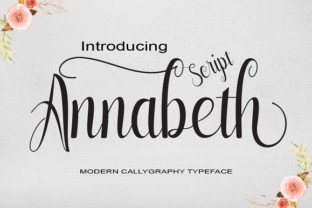
Annabeth is a fluid handwritten script from StudioRz—and it’s not just “pretty handwriting.” It’s a campaign-ready display font: rhythmic, slightly tapered, with natural entry/exit strokes and subtle contrast that gives it warmth without sacrificing clarity. It doesn’t try to mimic calligraphy tools or mimic brushwork—it feels like confident, practiced penmanship: relaxed but intentional, personal but polished. Its personality lands somewhere between “trusted mentor” and “creative collaborator”—ideal for brands building community, launching learning experiences, or highlighting human-centered offers.
Where Annabeth Earns Its Place in Real Campaigns
In practice, Annabeth shines where you need instant emotional resonance paired with visual distinction—especially in small, fast-consumed spaces:
- Instagram post headlines and Reels covers: Used at 48–64pt on light or soft-gradient backgrounds, Annabeth holds attention without competing with imagery. Its open letterforms (like the airy ‘a’, ‘e’, and ‘o’) breathe well even when overlaid on textured photos.
- YouTube thumbnails: At 56–72pt, it reads cleanly at thumbnail scale—especially when paired with bold color blocking behind the text. Avoid placing it over busy midground detail; reserve it for top-third or center-aligned focal zones.
- Pinterest pins and digital ad banners: Its rhythm helps guide the eye left-to-right, supporting quick scanning. On vertical pins, it works beautifully as a single-line title above a short benefit phrase in a clean sans serif.
- Email headers and landing page hero text: Not for body copy—but perfect for a 3–5 word campaign label (“Spring Studio Launch”, “New Workbook Out”, “You’re Invited”) that sets tone before the first sentence.
What Works—and What Doesn’t—At a Glance
Annabeth is built for impact, not exposition. It excels as display typography: headlines, quote graphics, course module titles, branded template labels, and limited-logo treatments (e.g., “Annabeth Studio” as a wordmark). Its strength lies in brevity and intention.
It’s less effective—or requires careful handling—in these situations:
- Paragraphs, captions, or any text smaller than 24pt on screen (legibility drops sharply below that size, especially on mobile).
- Dense layouts with tight line spacing—its generous x-height and flowing connections need breathing room.
- Formal corporate announcements, legal disclaimers, or data-heavy reports where neutrality and authority are primary goals.
- Dark-on-dark overlays unless backed with a subtle stroke or light drop shadow (test contrast early).
On mobile previews? Annabeth holds up best when used alone—no stacked lines, no tight kerning adjustments mid-sentence. One strong phrase. One clear focal point. That’s how it earns trust in under two seconds.
Smart Pairings and Practical Setup Tips
Annabeth thrives in contrast. My go-to pairing is a warm, humanist sans serif—think Inter, Manrope, or Clash Grotesk—for supporting text, subheads, and CTAs. The clean geometry of the sans balances Annabeth’s organic flow without feeling sterile. For editorial-style campaign assets (e.g., a mini-zine PDF or printable workbook cover), I’ll sometimes layer it over a quiet serif like IBM Plex Serif—but only when Annabeth remains the sole display voice.
Before dropping Annabeth into client files or templates, I always check:
- File formats: Does the package include both .OTF and .WOFF2? (Essential for web use and CMS uploads.)
- Stylistic alternates: Annabeth includes lowercase swashes and contextual ligatures—great for customizing “&”, “the”, or “and” in logos or social bios.
- Licensing scope: Script Amp fonts like Annabeth typically include commercial use, but verify if merchandise, SaaS platforms, or client reselling is covered—especially for agencies bundling fonts into branded template packs.
- Language support: It covers Latin-based languages well (including accented characters for French, Spanish, German), but doesn’t extend to Cyrillic or extended diacritics—keep that in mind for global campaigns.
A Font That Supports, Not Overrides, Your Message
What makes Annabeth feel different from other handwritten scripts isn’t just its curves—it’s its consistency of voice. It doesn’t shout. It doesn’t distract. It leans in. That’s rare in a display font meant for digital-first campaigns.
I’ve used it for a seasonal shop promotion (“Summer Sketch Kit – Now Live”), a webinar banner (“Let’s Talk Typography Ethics”), and a content series header (“Notes From the Studio”). In each case, Annabeth didn’t just “look nice”—it helped signal tone before the viewer processed a single word. It told them this wasn’t generic. This was curated. This had care behind it.
If you’re selecting fonts for a campaign—not just a logo or one-off graphic—think about how the typeface supports your audience’s scroll behavior, emotional state, and intent. Annabeth meets people where they are: mid-feed, mid-thought, mid-decision. It doesn’t ask for attention. It earns it—quietly, confidently, and every time.