Malanya: A Handwritten Font That Makes Your Campaigns Instantly Recognizable
It’s 9:47 a.m., and I’m zooming in on a YouTube thumbnail preview—tiny, fast-scrolling, half-swiped before the brain even registers the text. The headline reads “Your First 500 Subscribers” in a clean sans serif… but it blends. It’s polite. It’s safe. And in that split second, it’s forgettable. So I swap it out. I type the same phrase in Malanya. Suddenly, it breathes. Not flashy—just warm, intentional, human. Like someone wrote it just for that viewer. That’s when the thumbnail stops being background noise and starts being an invitation.
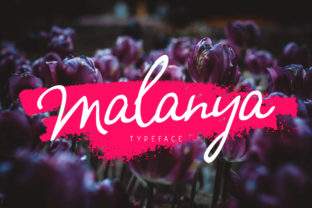
Malanya isn’t just another script font—it’s a stylistically confident handwritten typeface from Script Amp, designed with campaign clarity in mind. Its strokes have gentle contrast, subtle bounce, and consistent rhythm—not overly ornate, not stiffly uniform. Think of it as the kind of handwriting you’d see on a well-designed product tag, a thoughtful email banner, or the opening frame of a creator-led webinar series. It feels personal without sacrificing polish, expressive without losing legibility.
We used Malanya across a six-week Instagram content series for a small online shop launching a summer capsule collection. Not for body copy—never for paragraphs—but for every visual anchor: the “New Drop” label on Reels covers, the “Just Landed” stamp on Stories, the “Shop Now” callout overlaid on lifestyle photos. Why? Because in a feed where attention lasts under two seconds, Malanya delivers instant tonal alignment: friendly, curated, grounded. It doesn’t shout—it leans in.
Here’s what works—and where it shines:
- YouTube thumbnails & Shorts covers: Use at 36–48pt on high-contrast backgrounds (white text on deep teal, charcoal on cream). Its open letterforms hold up even when scaled down to mobile preview size.
- Pinterest pins: Perfect for quote graphics or seasonal promo banners—pair it with a light-weight sans serif (like Inter Light or Poppins Thin) for subheadings. The contrast makes hierarchy intuitive, not forced.
- Email banners & landing page headers: Great for short, action-oriented lines (“Join the Waitlist”, “Early Access Starts Friday”). Avoid long sentences—it’s a display font, not a workhorse.
- Digital ads & social promo carousels: Works especially well on image overlays with subtle drop shadows or soft background tinting. Its natural stroke variation adds texture without competing with photography.
- Branded templates (Notion, Canva, Figma): We dropped Malanya into reusable webinar announcement kits and course launch decks. Consistency came not from repetition alone—but from how instantly recognizable the font felt across formats.
Readability isn’t automatic—it’s intentional. On dark backgrounds, we always test Malanya at 24pt+ with 1.2 line-height and a crisp white or off-white fill. On light backgrounds, avoid ultra-thin weight overlays; instead, use its standard weight with a slight stroke expansion (0.5–1px) in design tools to prevent hairline loss on low-res screens. And yes—we checked thumbnails on three devices before finalizing: iPhone SE, Pixel 6, and iPad mini. Malanya passed every time.
Pairing is where Malanya really earns its place in your toolkit. It sings alongside neutral sans serifs (think Montserrat Regular, Lato Medium) for balance. We’ve also paired it successfully with warm serifs like Playfair Display Italic for editorial-style promo posts—though never with another script font. Two handwritten voices in one graphic create visual competition, not harmony. If you’re building a full typography system, treat Malanya as your expressive accent: one voice for emotion, one for clarity.
Before dropping it into client assets or ad templates, we always verify the license. Malanya is a commercial font—fully cleared for digital ads, Shopify banners, Canva templates, and even merch mockups—but only if you’ve purchased the full Script Amp license. We also check file formats: OTF and WOFF2 included, so web use is covered. No surprises. No last-minute swaps because the “free version” lacks ligatures or multilingual glyphs. (Spoiler: it supports Latin Extended-A, so accented characters in Spanish, French, and Portuguese render cleanly.)
One real moment sticks: designing a set of Pinterest pins for a wellness brand’s free challenge. The original draft used a generic brush script—too jagged, too chaotic. When we switched to Malanya for the “Day 3: Breathe Deeply” headline, the tone shifted immediately. Calmer. More trustworthy. Less “influencer trend,” more “trusted guide.” That subtlety matters—not as decoration, but as quiet persuasion.
Malanya doesn’t solve strategy. But it does sharpen execution. It helps your “Limited Stock” warning feel urgent but kind. Turns “You’re Invited” into something that lands like a personal note—not a broadcast. Makes “Sale Ends Tonight” feel less transactional, more communal. In a world of algorithmic noise, that kind of resonance isn’t accidental. It’s chosen. Deliberately.
So next time you’re tweaking a thumbnail, prepping a carousel, or building a branded template library—don’t default to “what’s available.” Ask instead: What voice does this message need right now? Then reach for Malanya. Not as filler. As function. As the quiet confidence behind every clear, memorable, human-first campaign.