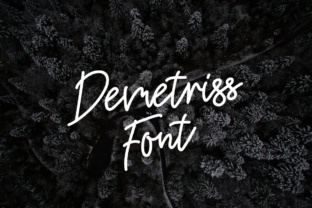
Demetriss: A Handwritten Font That Makes Your Brand Feel Human
Last Tuesday, I sat at my kitchen table—flour dust still on my apron—staring at a dozen printed versions of my new bakery’s jam label. The design was clean. The colors were warm. But something felt off. The type looked… generic. Like it had been pulled from a free font site and slapped on without thought. Customers told me the jars “felt special,” but the typography whispered “mass-produced.” That’s when I remembered Demetriss.
Demetriss isn’t just another script font. It’s a handwritten font with quiet confidence—fluid but never fussy, elegant but never stiff. Think of the gentle slope of a handwritten note from a friend: relaxed curves, natural rhythm, subtle variation in stroke weight. It has that rare balance—personable enough for a handmade soap label, polished enough for a boutique business card. And because it’s built by Script Amp, a trusted source for creative fonts, I knew it came with real craft behind it.
I tested Demetriss first on our “Honey Lavender” jam jar label. Used it only for the product name—not for ingredients or net weight—and suddenly, the whole thing breathed. The lowercase h and l have soft, open terminals; the uppercase H and L carry presence without shouting. Even better? It includes Cyrillic characters and full multilingual support—handy since we ship to Canada and occasionally get orders from EU customers who appreciate seeing their language rendered gracefully.
What really sealed the deal was the extras: ligatures that make “fi” and “fl” flow like ink on paper, a generous set of punctuation glyphs (those little flourishes around exclamation points and ampersands add so much charm), and numerals that don’t look like an afterthought. No more awkwardly swapping out “123” for a different font just to keep things cohesive.
Since switching to Demetriss, I’ve used it across touchpoints—each time with intention:
- Product labels: Perfect for short, evocative names (“Oat Milk Loaf,” “Cardamom Rose Cookies”)—never for fine print.
- Packaging design: Printed on kraft boxes, it holds up beautifully at 14–18pt. On matte sticker stock? Even better—the slight texture makes the hand-drawn quality pop.
- Social media graphics: Works brilliantly in Instagram carousel headers and Reels thumbnails—especially paired with a clean sans serif (I use Montserrat Light for body text) to create visual hierarchy without clutter.
- Thank-you cards & stickers: The lowercase alternates let me add a personal twist—like using a swash y at the end of “Thank you!”
- Café menu boards: Yes—even though I run a bakery, we serve coffee too. Demetriss shines in chalkboard-style digital menus when scaled large and spaced generously.
Here’s what surprised me: how much consistency this one font brought. Before, I’d mix three different scripts trying to “keep things interesting.” Now, Demetriss is our signature voice—and everything else supports it. Our website banner, seasonal email headers, even the tiny tag tied to gift boxes—they all share that same warm, human rhythm. Customers don’t say, “Oh, nice font.” They say, “Your brand feels so *you*.” That’s the power of intentional typography.
Is Demetriss right for every line of text? Not quite. It’s a display font, not a workhorse. I wouldn’t set a full ingredient list or shipping policy in it. But for anything that needs to be seen, felt, and remembered—logos, packaging titles, social bios, shop banners—it delivers warmth and distinction instantly.
Readability is thoughtful, too. On small jar labels (as low as 10pt), I stick to uppercase-only for maximum clarity—Demetriss’ uppercase set is strong and legible, with generous x-height and open counters. On mobile screens? I use it sparingly—always as headline text over a solid background, never over photos or busy patterns. And for printed packaging, I always check the .OTF files first (Script Amp includes both OTF and TTF), since OpenType gives better access to ligatures and alternates in design apps like Illustrator or Affinity Designer.
Pairing Demetriss is simple. My go-to is a neutral sans serif—something airy and unobtrusive like Inter or Lato—for supporting text. For a more editorial feel (think seasonal lookbooks or newsletter headers), I’ll pair it with a delicate serif like Playfair Display—but only for contrast, never competition. And if you’re tempted to layer it with another script font? Pause. Demetriss doesn’t need backup singers—it’s got presence, personality, and polish all on its own.
Before finalizing any use, I double-checked the commercial license—yes, it covers physical products, digital templates, client work, and even resale items like printable planners or branded stickers. That peace of mind matters when your livelihood depends on doing things right.
Typography isn’t about decoration. It’s about tone. It’s the difference between “We made this with care” and “We made this in a hurry.” Demetriss helped me say the former—quietly, confidently, and consistently. Whether you’re labeling candles, designing coaching worksheets, updating your café menu, or building an online shop that feels like a conversation—not a catalog—this handwritten font is more than a design choice. It’s the first sentence of your brand’s story. And sometimes, the most memorable stories begin with a single, well-chosen letter.