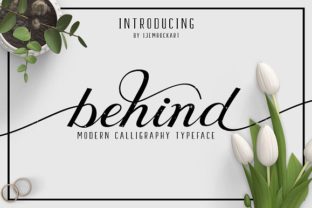
Behind: A Thoughtful Script Font for Editorial Calm
It started with a single line of text—“How to Begin Again”—set in three different fonts, side by side on my screen. I was redesigning a seasonal newsletter for a small wellness coaching practice, and the header needed to feel grounded but tender, intentional but unhurried. The first two options were lovely in their own right: one crisp and architectural, the other airy and minimalist. But neither held the quiet warmth I wanted—the kind that invites pause, not speed. Then I opened Behind.
Behind is a handmade calligraphy-style font from Script Amp—a collection known for expressive, human-centered typefaces. What struck me first wasn’t its flourishes or ligatures (though those are generous), but its rhythm. Each character leans just slightly forward, like breath before speech. There’s no aggressive contrast or sharp tension—just soft entry strokes, gentle exits, and subtle variation in weight that feels hand-drawn, not algorithmically smoothed. It doesn’t shout. It listens.
I used Behind for the newsletter header, pairing it with a warm, low-contrast serif for body copy—something like Lyon Text or Adobe Garamond. Instantly, the layout settled. The title became a threshold rather than a banner. Readers weren’t being addressed; they were being welcomed. That’s the editorial magic of Behind: it supports voice without competing with it.
In practice, Behind shines where tone matters more than density. It’s ideal for blog headers, ebook covers, chapter openers, and printable guides—especially those meant to be savored slowly. Think of a recipe ebook where each section begins with a short, lyrical heading (“The First Light of Spring,” “When the Oven Is Warm”), or a wedding guide where pull quotes float beside soft watercolor illustrations. Behind adds personality without pretense. Its 500+ decorative characters—including alternates, swashes, and contextual ligatures—let you shape nuance: a gentle underline beneath a subtitle, a graceful ampersand in a tagline, or a custom initial for a course workbook’s opening page.
That said, Behind isn’t built for long-form reading. It’s a display font—not a workhorse. You wouldn’t set a 12-page PDF report in it, nor would you use it for navigation menus or dense captions. Its strength lies in moments of emphasis: a title that lingers, a quote that resonates, a cover that breathes before the first paragraph begins. For digital magazine layouts, I’ve used it sparingly—only for feature titles and section dividers—then stepped back into a clean sans serif (like Inter or Sofia Pro) for decks, bylines, and body text. The contrast creates breathing room. The hierarchy feels intuitive, not imposed.
Readability across formats is thoughtful but requires intention. On screen, Behind holds up beautifully at 24–36pt for headers—even on mobile, where I tested it in responsive email templates. In PDF exports, it renders cleanly when embedded (always check your export settings), and for printables—like guided journal pages or planner inserts—it adds tactile elegance without sacrificing clarity. Just avoid ultra-thin weights at small sizes; stick to its medium or bold variants for maximum legibility in physical formats.
Font pairing is where Behind reveals its quiet confidence. It pairs naturally with serifs that share its warmth—think Miller, Tiempos, or even a relaxed Georgia—but also surprises beautifully with restrained sans serifs: a modest weight of Poppins, the quiet geometry of Suisse Int’l, or the friendly neutrality of Lato. What matters most is contrast in function, not just form. Let Behind carry the emotional weight; let your body font carry the information. That balance is what makes editorial design feel generous, not cluttered.
I’ve used Behind across several real projects this season: a digital magazine’s seasonal cover series (paired with a light serif for subtitles and a monospace for credits), a printable coaching workbook (where its swash capitals introduced each reflection prompt), and a small-batch recipe zine (with hand-drawn icons and ample white space). In each case, it didn’t dominate—it deepened. It made the typography feel like part of the content’s intention, not just its container.
Before using Behind in client work or digital products, I always double-check a few practical things. First, licensing: Script Amp offers commercial licenses suitable for ebooks, templates, printables, and paid newsletters—no hidden restrictions, but always verify scope if you’re bundling fonts with downloadable assets. Second, file formats: Behind comes in OpenType (.otf), which supports advanced typographic features in professional design apps (Illustrator, InDesign, Affinity) and modern web environments via variable or static web fonts. Third, multilingual support: it includes extended Latin characters, so it works well for English, French, Spanish, Portuguese, and German—but verify coverage if you’re publishing in broader European or Eastern languages.
What stays with me isn’t just how Behind looks—but how it changes the pace of the page. In a world of rapid-scrolling feeds and clipped headlines, choosing a font like Behind feels like an act of editorial care. It asks the reader to slow down just enough—not because it’s difficult to read, but because it’s pleasant to linger. It doesn’t chase attention; it earns it, quietly.
If you’re building something meant to be felt as much as read—a wedding guide that honors slowness, a coaching workbook that invites reflection, a newsletter that begins with presence—Behind offers more than style. It offers stillness, shaped in ink.