Strike Alone: A Thoughtful Script Font for Editorial Warmth
It was a quiet Tuesday morning—coffee still warm, inbox cleared, and the final layout for a seasonal lifestyle blog redesign open on my screen. I’d spent weeks refining the tone: grounded but inviting, intentional but unhurried. The photography felt right. The voice felt consistent. But the header font—the first thing readers see—still didn’t settle. It was either too stiff or too fussy. Then I opened Strike Alone.
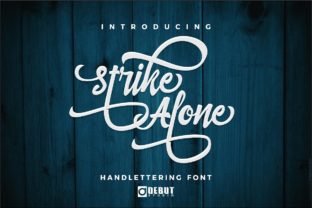
Right away, it felt like a breath. Not flashy. Not demanding attention for its own sake. Just quietly confident—a hand-lettered script with gentle contrast, soft entry and exit strokes, and that subtle vintage rhythm Debut Studio describes so well. It’s not retro in a kitschy way; it’s retro in the way a well-worn linen napkin feels—softened by use, full of quiet character.
A Font That Holds Space, Not Noise
In editorial design, especially for digital-first content like newsletters or blog features, type must do two things at once: express mood *and* support clarity. Strike Alone excels at the former without sacrificing the latter—when used intentionally. Its letterforms have just enough variation to feel human, but not so much that they distract from meaning. The lowercase ‘a’ and ‘g’ are open and legible; the ascenders and descenders flow with purpose, never collapsing into each other—even at 28pt on a retina display.
I tested it across several real layouts: a recipe ebook cover (paired with a warm, textural serif for body copy), a printable coaching workbook’s chapter openers, and a digital magazine’s pull quotes. In every case, Strike Alone added warmth without compromising structure. It doesn’t shout “look at me”—it invites the reader in, then steps back to let the content breathe.
Where It Shines—and Where It Steps Aside
This is a display font, first and foremost. Think of it as the thoughtful host at a dinner party: present, attentive, and expressive—but not the one doing all the talking. It’s ideal for:
- Blog headers and article titles (especially lifestyle, wellness, or creative-focused sites)
- Ebook and guide covers (wedding guides, seasonal planners, slow-living workbooks)
- Newsletter graphics and social media banners where tone matters more than density
- Pull quotes in long-form editorial features—its swashes add elegance without overwhelming
- Printable planners and worksheets where handwritten charm supports intentionality
What it’s not designed for—and this is important—is body copy, tight captions, or dense informational tables. Its personality lives in gesture and flow, not compact legibility. At small sizes or in high-contrast print settings, some of the finer swash details soften or blur. That’s not a flaw—it’s a feature of its category: a premium script font built for moments of emphasis, not endurance.
Pairing With Purpose
One of the quiet joys of working with Strike Alone is how gracefully it pairs. Because it carries so much mood on its own, it asks for balance—not competition. I’ve found it works beautifully alongside:
- A relaxed serif (like Literata or Adobe Garamond) for body text—offering warmth and readability in equal measure
- A clean, neutral sans serif (such as Inter or Lato) for navigation, subheads, or captions—creating gentle contrast without visual tension
- Even modest typewriter-style monospaced fonts for footnotes or asides, when aiming for tactile authenticity
The key is contrast in function, not style. Let Strike Alone carry voice and identity. Let the supporting type carry information and flow.
Practical Notes for Real Publishing Work
Before importing Strike Alone into your next project, take a moment to explore what’s included. As a Script Amp font, it comes with a thoughtful set of extras: multiple swash alternates, contextual ligatures, and OpenType features that activate automatically in design apps like Illustrator or Affinity Publisher. These aren’t decorative flourishes—they’re functional tools. A single well-placed swash on a chapter title can shift the entire tone of a page.
Licensing is straightforward but worth checking: it’s a commercial font, fully cleared for use in client work, digital downloads, ebooks (EPUB and PDF), and even newsletter templates you sell. No hidden restrictions—just clear permissions aligned with how independent creators actually work.
For print projects, test export settings carefully. While Strike Alone renders cleanly in most PDF workflows, embedding the font (rather than outlining) preserves editability and ensures swashes remain crisp at high resolution. On screen, it performs reliably across modern browsers and email clients—though always preview on mobile, where letter spacing and line height become more visible.
A Quiet Confidence in Every Curve
There’s a growing fatigue with fonts that try too hard—to be bold, trendy, or algorithmically “engaging.” Strike Alone offers something different: quiet confidence. It doesn’t chase attention. It earns it—through consistency, craft, and care.
Whether you’re designing a slow-living newsletter, laying out a heartfelt wedding guide, or building a printable planner that feels like a conversation rather than a checklist—this font understands the weight of pause, the value of space, and the power of a single, well-drawn letter.
It’s not the loudest voice in the room. But when it speaks, people lean in.