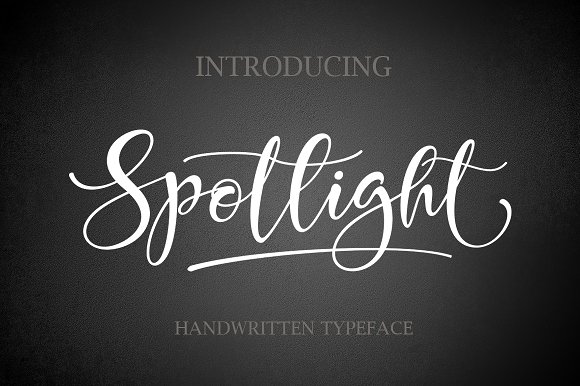
Spotlight: A Hand-Painted Script Font for Digital Brand Moments
Last week, I was refining the hero section of a new coaching website — clean layout, soft gradients, intentional whitespace — and realized the headline needed more than clarity. It needed warmth. Character. A quiet confidence that felt human, not algorithmic. That’s when I pulled up Spotlight.
Spotlight isn’t just another script font. It’s a Script Amp typeface built from over 490 hand-painted characters, digitally refined to preserve organic flow without sacrificing screen legibility. The strokes breathe — slightly uneven, gently tapered, with subtle texture baked into each curve. It doesn’t shout. It leans in. That made it perfect for a headline like “Your First Step Into Calm” — short enough to land, expressive enough to resonate.
I tested it across real scenarios: as a hero title over a muted image banner, as a section heading above testimonial cards, and even as a subtle accent on a CTA button (“Begin Your Session”). In every case, Spotlight elevated tone without compromising usability. Its rhythm guides the eye naturally — not by forcing attention, but by inviting pause. On mobile, I kept the size at 28px minimum with generous letter-spacing (0.03em), and it held up beautifully. No jagged edges, no pixelated curves. Just smooth, confident presence.
Where Spotlight shines most is in moments that ask users to *feel* before they act. Think of a boutique online store’s seasonal campaign banner (“Summer Slow Down”), a course sales page’s key benefit headline (“Learn at Your Own Rhythm”), or a portfolio site’s intro line (“Design That Listens”). It’s not meant for body copy, navigation labels, or dense feature lists — those need neutrality and speed. But for hero titles, section headers, quote pulls, email subject lines, or social media graphics? Spotlight adds polish without pretense.
Readability stays strong because it’s been thoughtfully engineered — not just scanned or stylized. The x-height is generous, counters are open, and baseline consistency is tight. I tested it over both light and dark backgrounds (using CSS blend modes where needed) and found it equally effective. On image overlays, I used a soft 15% white overlay behind the text to ensure contrast without obscuring the background. For fast-loading visual content, Spotlight’s webfont files are lean — WOFF2 included — and load cleanly alongside system fonts in modern browsers.
Pairing Spotlight is intuitive. I almost always pair it with a warm, neutral sans serif — think Inter, Poppins, or Manrope — for body text and UI elements. The contrast works: Spotlight brings personality; the sans brings trust and function. For a more editorial brand (say, a mindful blog or digital magazine), I’ve paired it with a gentle serif like Cormorant Garamond — the script becomes the voice, the serif becomes the conversation. What matters is balance: never two decorative fonts competing for attention, never a heavy script against a thin, fragile sans.
In practice, I used Spotlight for three distinct areas on the coaching site:
- Hero headline — set at 48px on desktop, 32px on tablet, 28px on mobile, with 0.02em tracking
- Section divider — “What Clients Say” rendered in Spotlight at 24px, centered, with light top/bottom padding
- Email opt-in header — “Join the Quiet Circle” styled in Spotlight, followed immediately by body copy in Inter Regular
Each use reinforced how much typography contributes to perceived care. When users see thoughtful type, they assume thoughtful design — and by extension, thoughtful service. That subtle shift in perception matters, especially on high-intent pages like course signups or service inquiries.
Before deploying Spotlight in production, I double-checked what’s included: full Latin character set, standard punctuation, ligatures, stylistic alternates (great for avoiding repeated letterforms in headlines), and commercial licensing that covers client websites, SaaS dashboards, and digital templates. No surprises — no missing accents, no unsupported languages for English-first audiences, no hidden fees for e-commerce use. As a premium font, it’s priced fairly for what it delivers: authenticity, polish, and versatility within its lane.
It’s worth noting Spotlight isn’t trying to be everything. It won’t replace your workhorse sans for interface text, nor does it aim to mimic calligraphy tools like Procreate brushes. It’s a focused display font — purpose-built for moments where your brand speaks first. That focus makes it reliable. I’ve used it in landing pages, campaign microsites, digital brand kits, and even SVG-based social banners — always with consistent results.
One thing I appreciated during implementation: no rendering hiccups. No flicker on load, no FOIT or FOUT drama. Because it’s optimized for the web, and because the designer clearly prioritized performance alongside aesthetics, Spotlight integrates smoothly — no extra CSS gymnastics required. Just declare it, apply it, and trust it.
If you’re choosing a script font for your next digital project, ask yourself: Does it support your brand’s emotional intent? Does it scale gracefully across devices? Does it coexist respectfully with functional type? Spotlight answers yes to all three — not with flash, but with fluency. It’s the kind of creative font that disappears into the experience while making everything around it feel more considered.
For web designers, UI designers, and digital product creators who believe typography is part of the user journey — not just decoration — Spotlight is less of a “font choice” and more of a quiet alignment. It doesn’t distract. It deepens. And in an age of sameness, that’s rare.