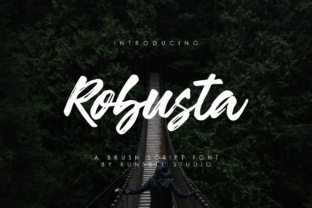
Robusta Font: A Sporty, Confident Script for Small Business Branding
If you’re a small business owner juggling branding, packaging, social posts, and customer emails—then you know how much weight a single font carries. Robusta isn’t just another script font. It’s a brush-style script with quick-dry strokes and unmistakable energy—designed to feel adventurous, fun, and grounded all at once. As someone who’s hand-labeled candles, designed café menus, and built Instagram templates from scratch, I’ve learned that the right script font doesn’t just look good—it signals who you are before a customer reads a word.
Robusta works best where personality matters most: your logo, product labels, website hero banners, and even handwritten-style thank-you cards. Its bold entry strokes and confident exit tails give it presence without sacrificing legibility—especially at larger sizes. That means it holds up beautifully on a craft beer bottle label, a boutique shopping bag, or a digital ad thumbnail. Unlike overly delicate scripts, Robusta avoids looking fragile or fussy. It feels active, approachable, and human—perfect for brands rooted in movement, wellness, outdoor gear, handmade goods, or playful service offerings.
Think about how Robusta could shape real materials. A local trail-running coach might use it for their logo and class schedule posters—pairing it with a clean sans serif like Inter or Montserrat for body text. A small-batch soap maker could stamp Robusta across kraft paper labels, letting the texture of the paper and the ink’s natural variation enhance its brush character. A café owner might feature Robusta in their chalkboard-style menu headers, then switch to a warm serif like Lora for daily specials—keeping contrast high and tone cohesive.
For packaging, Robusta shines as a display font—not for fine print, but for names, slogans, and key descriptors. On a 2 oz candle jar, “Wild Sage” in Robusta reads clearly at 18pt, especially when paired with ample spacing and a solid background. On Instagram, it pops in Stories and Reels overlays because its thick-thin contrast translates well on mobile screens—even compressed. Just avoid using it below 14pt in print or below 16px online for body copy; it’s not built for long paragraphs, and that’s okay. Let it do what it does best: lead with confidence.
How Robusta Builds Consistency Without Limiting Flexibility
Consistency isn’t about repeating the same thing everywhere—it’s about making every touchpoint feel like it belongs to the same thoughtful, intentional brand. Robusta helps by acting as your visual anchor. When customers see it on your website banner, then again on your shipping sticker, then on your Instagram highlight cover, they begin to associate that rhythm and energy with your business. That recognition builds trust faster than any tagline.
Because Robusta is part of the Script Amp collection—a curated set of expressive, high-quality fonts—it’s engineered for real-world use. That means carefully spaced characters, OpenType features like alternate glyphs and ligatures (great for avoiding awkward letter collisions), and reliable cross-platform rendering. You won’t get unexpected line breaks or missing accents when exporting PDFs for your printer—or when uploading SVGs for your web developer.
Smart Pairings That Keep Your Brand Readable and Real
No script font should go solo—and Robusta is no exception. Its strength lies in contrast. Pair it with a neutral, highly legible sans serif (like Poppins, Work Sans, or even system fonts like Helvetica Neue) for supporting text. This combo works across mediums: your website navigation stays scannable, your email newsletter remains accessible, and your product tags stay clear at a glance.
For a warmer, more tactile feel—especially in print—try Robusta with a friendly serif like Merriweather or Cormorant Garamond. This pairing adds sophistication without stiffness, ideal for artisanal food brands, wedding stationery, or holistic wellness services.
Here’s what to avoid: stacking Robusta with another decorative font, or using it alongside ultra-thin or overly geometric typefaces. The goal is harmony, not competition. If it feels busy or hard to parse at first glance, simplify.
Testing Robusta the Practical Way
Before committing across your entire brand, test Robusta in three places you actually use: your most-viewed social graphic, your top-selling product label, and your homepage headline. Print a mockup of your packaging at actual size. View your Instagram Story on an iPhone—not just desktop preview. Ask two customers (not designers) what feeling the font gives them. Does it match how you want people to experience your brand? If yes, you’re on solid ground.
Also check licensing. Robusta is a commercial font, so confirm your license covers usage on physical products (like stickers or mugs), digital templates you sell, client work, and embedded web use. Most reputable vendors—including Script Amp—offer clear licensing tiers. Don’t assume a personal-use license covers your Etsy shop or Shopify store.
When Robusta Fits—and When It Doesn’t
Use Robusta when you want to communicate energy, authenticity, and approachability—especially if your audience values craftsmanship, movement, or joyful simplicity. It’s strong in logos, headlines, packaging accents, social media quotes, and event signage.
It’s less ideal for formal legal documents, medical clinic brochures, or B2B SaaS dashboards where neutrality and precision take priority. And while it handles short phrases beautifully, skip it for paragraph-length descriptions or multilingual content with complex diacritics unless you’ve verified full language support.
At its core, Robusta is a tool—not a magic fix, but a thoughtful one. It won’t replace great photography or smart messaging. But when chosen intentionally and applied consistently, it helps your small business stand out—not by shouting, but by showing up, confidently and unmistakably, wherever your customers meet you.