Mr. Lonely: A Handmade Script Font for Digital Brand Identity
As a UI designer who builds landing pages, SaaS dashboards, and boutique e-commerce experiences, I reach for script fonts sparingly—but when I do, it’s because they carry unmistakable voice. Mr. Lonely is one of those rare display fonts that feels both intentional and human: a handmade brush script with warmth, rhythm, and quiet confidence. It’s not just decorative—it’s functional typography designed to anchor digital tone without sacrificing clarity.
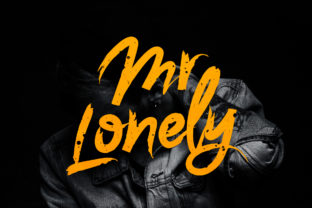
Visually, Mr. Lonely balances organic flow with structural consistency. Each lowercase and uppercase letter carries subtle brush texture—visible on hover states or large-screen headers—but remains legible at 32px and above. The generous x-height, open counters, and carefully tuned spacing mean it doesn’t collapse on mobile viewports or blur in low-DPI environments. Unlike many script fonts that rely on exaggerated swashes or tight kerning, Mr. Lonely uses natural ligatures and gentle entry/exit strokes to guide the eye—not distract from it.
Where Mr. Lonely Earns Its Place in Your Layout
In practice, Mr. Lonely shines where personality meets purpose: hero section headlines, brand logotypes, testimonial quotes, course title cards, and limited-run product banners. It works especially well for creative studios, wellness coaches, independent publishers, and premium online stores—any brand that wants to signal authenticity without leaning into clichéd “handwritten” tropes.
- Landing pages: Use Mr. Lonely for H1s paired with a neutral sans serif (like Inter or Manrope) for body copy—creating immediate contrast while maintaining scannability.
- Online stores: Apply it to collection headers (“New Arrivals”, “Curated Picks”) or limited-edition labels—not product names, but the framing language around them.
- App onboarding: Deploy Mr. Lonely in welcome modals or milestone badges (“You’re all set!”) to soften technical interfaces with approachable tone.
- Portfolio sites: Let it introduce your name in the masthead or sign off case study summaries—adding signature-level distinction without competing with visual content.
Readability & Responsiveness: Practical Considerations
Mr. Lonely isn’t built for paragraphs—and it shouldn’t be. Its strength lies in short-form impact: 1–6 words max per line in most contexts. On mobile, keep usage to headings ≥28px with at least 1.3 line-height. Avoid stacking multiple lines of Mr. Lonely in tight containers; instead, use it as a single focal point, then step down to a highly legible web-safe fallback for supporting text.
It performs reliably across backgrounds. On light surfaces, its medium-dark weight holds presence without harsh contrast. Over muted imagery or soft gradients, it remains readable—especially when applied with subtle text-shadow (1px black @ 20% opacity) for lift. On dark mode, test against #121212 or deeper: the font’s ink-like density avoids washing out, unlike lighter scripts that vanish in low-light UIs.
Font Pairing That Supports, Not Competes
Script fonts live or die by their pairings. With Mr. Lonely, simplicity wins. Pair it with a clean, variable sans serif—Inter, Poppins, or Space Grotesk—for body, buttons, and navigation. Their geometric neutrality gives Mr. Lonely room to breathe and assert tone. For editorial or luxury-facing sites, try a refined serif like Literata or Crimson Pro: the contrast between Mr. Lonely’s fluidity and the serif’s measured structure creates layered sophistication.
Avoid pairing with other scripts, condensed fonts, or high-contrast serifs—they’ll clash tonally or visually compete for attention. And skip system fonts like Arial or Times New Roman; their dated proportions undermine Mr. Lonely’s crafted intent.
Multilingual Support Meets Real-World Usage
What makes Mr. Lonely unusually versatile for global digital products is its full Cyrillic set, extended Latin characters, and broad punctuation coverage—including curly quotes, em dashes, and fraction numerals. If you’re building a bilingual SaaS site, launching a course in English and Spanish, or designing packaging assets for EU markets, this isn’t just nice-to-have—it’s operational necessity. No need to swap fonts mid-layout or risk missing glyphs in translated CTAs.
It ships in modern webfont formats (WOFF2 included), supports CSS font-display: swap for fast loading, and includes OpenType features like stylistic alternates and discretionary ligatures—useful for fine-tuning brand expression across touchpoints.
Licensing That Fits How You Actually Ship Work
Mr. Lonely is a commercial font, meaning it’s licensed for active use—not just previewing. Whether you’re embedding it in a client’s WordPress site, bundling it into a Figma design system, shipping it with a Shopify theme, or using it across social media graphics and email headers, the license covers those scenarios. Just verify your chosen plan includes web, desktop, and app usage—especially if you’re reselling templates or white-labeling digital products.
For agencies and freelancers, this eliminates last-minute font swaps before handoff. No more swapping to generic Google Fonts because licensing was unclear. You can commit to Mr. Lonely early in the design process—and know it’ll hold through development, QA, and launch.
Not Every Font Needs to Be Everywhere
Mr. Lonely doesn’t try to be your system font. It doesn’t replace your body typeface or navigation bar styling. Instead, it serves as a deliberate accent—a signature gesture in your digital language. Used thoughtfully, it strengthens visual hierarchy, deepens brand recall, and quietly signals care in execution. That matters when users decide whether to scroll, click, subscribe, or trust.
In an ecosystem saturated with algorithmic fonts and AI-generated variants, Mr. Lonely stands out precisely because it’s handmade—not mass-produced. Its imperfections are calibrated. Its rhythm is intentional. And in the right context—on the right screen, at the right size—it doesn’t just look good. It communicates.