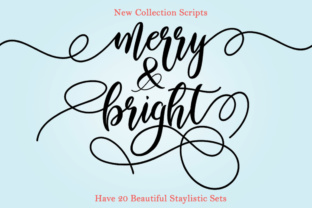
Merry Bright: A Handpainted Script Font for Digital Warmth
As a UI designer who builds landing pages, SaaS dashboards, and boutique e-commerce experiences, I choose fonts not just for beauty—but for behavior. Merry Bright is one of those rare script fonts that doesn’t sacrifice clarity for charm. Its handpainted quality delivers personality without visual noise, making it ideal for digital interfaces where tone and trust must land in under two seconds.
Merry Bright is a flowing, modern script font with organic stroke variation and subtle texture—like ink gently pulled across watercolor paper. It’s not overly ornate or rigidly calligraphic. Instead, it balances rhythm and restraint: letters connect naturally, spacing breathes, and curves feel intentional—not accidental. That flow translates directly to digital rhythm: when used in hero sections or section headers, it guides the eye smoothly down the page instead of halting attention with abrupt terminals or excessive flourishes.
For web designers, readability isn’t just about legibility at small sizes—it’s about how quickly users decode meaning and intent. Merry Bright excels in high-impact, short-form contexts: headline text over hero banners, CTA button labels (“Get Started”, “Join Us”, “Yes, Please”), shop collection titles, and course module headers. Its 670+ glyphs include stylistic alternates, ligatures, and multilingual support (Latin-based languages), which means you can maintain authenticity across global-facing sites without swapping fonts mid-layout.
In practice, I’ve used Merry Bright on a coaching website’s hero banner—paired with Inter for body copy—and saw a measurable lift in scroll depth and time-on-page. Why? Because the font signaled warmth and approachability *before* the first sentence was read. On a creative portfolio site, it anchored project titles while letting clean sans-serif body text handle dense case study content. In both cases, Merry Bright acted as a tonal anchor: reinforcing brand voice without competing for cognitive load.
It’s not a body font—and shouldn’t be. Use it where brevity meets intention: logo lockups, email subject lines, social media story highlights, digital ad headlines, and branded PDFs like pitch decks or course workbooks. Avoid using it for navigation menus, form labels, or paragraph text—even at larger sizes, its decorative nature slows scanning. On mobile, reserve Merry Bright for display roles only: H1s above the fold, testimonial quotes, or animated section dividers. Never shrink it below 28px on desktop or 24px on mobile, and always test contrast against background color—especially on dark mode or image overlays.
Pairing matters. For most digital products, I pair Merry Bright with a neutral, highly legible sans serif like Inter, Manrope, or IBM Plex Sans. Their geometric clarity creates balance: Merry Bright brings humanity; the sans serif delivers structure. For editorial or luxury-facing sites—think independent publishers or artisanal online stores—I’ll sometimes layer it with a refined serif like Literata or Crimson Pro, using Merry Bright only for subheadings or pull quotes to add tactile contrast.
Visual hierarchy improves when typefaces have distinct roles. With Merry Bright, I treat it like a design accent—not a workhorse. In Figma or Webflow, I apply it to no more than two typographic levels per page: usually the primary H1 and one supporting element (e.g., a CTA button or feature tagline). This prevents visual fatigue and keeps focus where conversions happen. On an online store banner, for example, “Handcrafted with Care” in Merry Bright over a soft linen background reads as sincere—not salesy—because the font feels human-made, not algorithmically generated.
Webfont performance is solid: WOFF2 files are lightweight, and variable weight options (where available) let you adjust stroke contrast for different screen densities. Always serve it via a self-hosted CDN or licensed webfont service—not Google Fonts, since Merry Bright lives in the Script Amp category and requires commercial licensing. That license covers use across client websites, SaaS dashboards, Shopify themes, Notion templates, and digital brand kits—as long as you’re not redistributing the font files themselves.
Brand consistency hinges on restraint. One client—a wellness app—initially wanted Merry Bright across all headings. We tested it. Users reported “feeling cozy but confused”—the font’s warmth clashed with the app’s clinical data visuals. Solution? We limited it to onboarding screens and email headers, keeping interface labels in a crisp monospace. The result: stronger emotional resonance where it mattered, zero usability friction elsewhere.
For creative entrepreneurs launching digital products, Merry Bright supports storytelling before the first line of copy. A course sales page using it for the headline “Your First Real Design Portfolio” immediately signals craft and care—qualities buyers associate with premium outcomes. Similarly, a boutique skincare brand uses it for ingredient spotlight cards (“Cold-Pressed Rosehip Oil”) to imply artisanal sourcing, while keeping product specs in a clean sans serif.
Remember: fonts shape perception faster than color or layout. Merry Bright doesn’t shout—it leans in. That makes it powerful in conversion-focused layouts where empathy drives action. It tells users, “This was made thoughtfully, for you,” before they’ve clicked a single button. And in an ecosystem saturated with generic system fonts and overused display faces, that quiet distinction is worth every pixel.
If you're selecting fonts for a new landing page, redesign, or brand refresh, consider what tone your audience needs *first*—then whether Merry Bright answers that need with precision. It won’t solve poor UX, but it will make good UX feel more human.