High Desert: A Distinctive Script Font for Digital Branding
As a UI designer who builds landing pages, SaaS dashboards, and boutique e-commerce experiences, I reach for fonts that do more than look good—they reinforce tone, guide attention, and hold up across devices. High Desert, a premium script font from Darwinoo in the Script Amp collection, is one of those rare display fonts that balances expressive character with functional clarity.
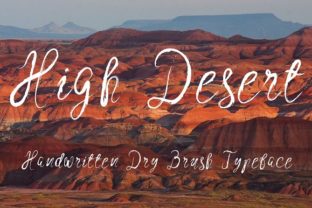
Visually, High Desert leans into modern calligraphic rhythm—fluid yet controlled, with subtle contrast between thick downstrokes and delicate hairlines. It’s not overly ornate or tightly connected like traditional cursive fonts, which makes it far more legible at smaller sizes and on screen. The letterforms have gentle warmth and organic movement, but avoid the fragility that plagues many handwritten fonts when scaled down or rendered on lower-DPI displays.
In practice, High Desert excels where personality meets purpose: hero section headlines, product name tags, course title banners, and brand-focused content blocks. Its natural cadence supports scanning behavior—users grasp meaning quickly because spacing and stroke weight create clear visual anchors. On a coaching website’s headline (“Your Next Breakthrough Starts Here”), High Desert adds sincerity without sacrificing polish. On a ceramic studio’s online shop banner (“Hand-Thrown • Small Batch • Made in Arizona”), it reinforces craft and authenticity without leaning into cliché.
For conversion-focused layouts, High Desert works best in short, high-impact roles: H1s, subheadings above CTAs, button labels (when sized appropriately), and logo lockups. It’s not ideal for body copy, navigation menus, or dense paragraph text—but that’s by design. As a script font, its strength lies in contrast. Pair it with a clean, neutral sans serif like Inter, Manrope, or Poppins for body text and interface elements. That pairing creates immediate hierarchy: High Desert sets the emotional tone; the sans serif delivers information efficiently.
On mobile screens, use High Desert sparingly—and always test. At 28–36px on iOS Safari or Chrome Android, it remains highly legible in hero sections, especially against solid backgrounds. For buttons or small CTAs, stick to sizes no smaller than 20px and ensure generous letter-spacing (0.5–1px) to prevent crowding. Avoid tight tracking or all-caps usage—it diminishes readability and weakens the font’s natural flow.
Background matters. High Desert performs well over light gradients, soft image overlays, and muted solid colors—but avoid busy textures or low-contrast combinations (e.g., light gray text on off-white). On dark mode interfaces, use a crisp white or warm off-white (#f8f5f2) rather than pure #ffffff to preserve its organic feel. Its slight irregularity shines against simplicity, not chaos.
Where High Desert Fits in Your Design System
Think of High Desert as your brand’s voice—not its entire vocabulary. Use it deliberately:
- Landing page headers: Instantly signals creativity, care, and intentionality—ideal for design studios, wellness brands, and indie makers.
- Online store banners: Elevates product storytelling—especially for artisanal goods, subscription boxes, or limited-edition drops.
- Course and digital product pages: Adds distinction to titles like “Foundations of Visual Thinking” or “The Mindful Designer Toolkit.”
- Portfolio site accents: Works beautifully for project names, client quotes, or section dividers—never full paragraphs.
- Social media graphics and email headers: Maintains consistency across platforms when exported as SVG or embedded via webfont.
It’s less effective for legal disclaimers, form labels, or data-dense dashboards—contexts where neutrality and speed trump expression. That’s not a limitation; it’s thoughtful specialization.
Practical Considerations for Web Use
High Desert ships as a webfont-ready package with WOFF2 support—critical for fast loading and LCP optimization. It includes standard Latin characters, basic punctuation, and common diacritics, covering English, Spanish, French, and German use cases. While it doesn’t offer multiple weights (it’s a single-display style), Darwinoo includes stylistic alternates—like swash capitals and contextual ligatures—that add nuance when enabled via font-feature-settings in CSS.
Licensing is straightforward: the commercial license covers websites, client projects, SaaS apps, online stores, and digital templates—as long as you’re not reselling the font files themselves. No monthly subscriptions, no per-page fees. Just one-time purchase, full usage rights for your digital assets—including branded email campaigns and downloadable PDFs tied to your domain or product.
Pairing suggestions go beyond utility. Try High Desert with a warm serif like Cormorant Garamond for editorial-style blogs or newsletter headers—creating a hybrid voice that feels both timeless and human. Or pair it with a geometric sans like Clash Grotesk for contrast that feels intentional, not accidental. The goal isn’t visual harmony at all costs—it’s tonal alignment.
What sets High Desert apart from other script fonts is how little it asks of your layout. It doesn’t require heavy kerning adjustments, custom line-height overrides, or fallback gymnastics. It works out of the box—on modern browsers, with standard CSS typography properties, and within responsive frameworks. That reliability matters when you’re shipping a client site under deadline or iterating on a product landing page before launch.
Ultimately, High Desert isn’t about decoration—it’s about resonance. When your audience lands on a page and sees a headline set in High Desert, they don’t just read the words. They register confidence, craftsmanship, and a point of view. In digital spaces crowded with generic type, that distinction is measurable—in time-on-page, scroll depth, and conversion lift. Choose it where meaning needs emphasis. Trust it where brand identity meets interface.