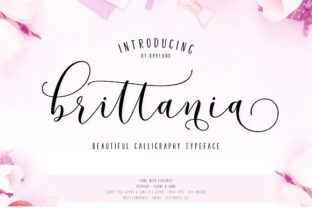
Brittania: A Modern Script Font for Digital Branding
As a UI designer who ships dozens of landing pages, SaaS dashboards, and e-commerce experiences each year, I treat fonts like foundational design systems—not just decorative choices. When Brittania landed in my type library, it stood out not for novelty, but for precision. It’s a modern calligraphy font built for the web: elegant, intentional, and engineered to perform where users actually interact—with screens, not print.
Every letterform in Brittania flows with subtle rhythm and consistent stroke contrast. There are no abrupt terminals or exaggerated flourishes that break visual continuity. Instead, you get soft entry/exit strokes, balanced x-heights, and generous spacing baked into the metrics—so it renders cleanly at 32px on a hero banner and remains legible at 24px on a mobile CTA button. That balance is rare in script fonts, especially ones designed for digital-first use.
Where Brittania Earns Its Place in Your Layout
Brittania isn’t meant for body copy—and it shouldn’t be. Its strength lies in strategic emphasis: guiding attention, reinforcing voice, and anchoring tone without competing with content. Here’s where it delivers real design leverage:
- Hero section headlines: Paired with a neutral sans serif (like Inter or Manrope), Brittania adds warmth and distinction to value propositions—especially for creative services, coaching brands, or boutique product launches.
- Landing page subheads and section dividers: Use it sparingly to break monotony between content blocks. A single line like “Designed for clarity” in Brittania carries more emotional weight than bold sans serif text.
- CTA buttons and micro-interactions: At 18–20px on light backgrounds, it reads confidently—even with subtle hover animations. Avoid using it on dark backgrounds unless you increase contrast significantly or add a light stroke.
- Logo lockups and brand wordmarks: The included alternates (swash capitals, contextual ligatures) let you craft custom logo treatments without needing vector manipulation. Just embed as SVG or variable font where supported.
- Digital ads and social banners: Its high recognition factor means viewers grasp your brand’s personality in under two seconds—critical for scroll-stopping performance on Instagram or LinkedIn feeds.
Readability & Responsiveness: Practical Considerations
Brittania performs well across breakpoints—but only when used intentionally. On mobile, limit usage to headline-level elements above the fold. Never shrink it below 20px on iOS or Android; optical scaling matters more than pixel-perfect consistency. For image overlays, always apply a subtle semi-transparent background or text shadow to ensure legibility against complex photos.
It includes OpenType features like discretionary ligatures and stylistic sets—use them selectively. Overusing swashes in paragraph headings can slow scanning. One well-placed alternate (e.g., the elegant “&” or descending “y”) often communicates more than three flourished letters.
Smart Pairings for Web Design Systems
Brittania thrives alongside functional typefaces. Think of it as the “voice” and your secondary font as the “ears.” For clean, conversion-focused sites, pair it with a humanist sans serif—Inter, Poppins, or even IBM Plex Sans—for all interface text, forms, and navigation. For editorial or lifestyle brands, try a low-contrast serif like Lora or Crimson Pro in body copy to echo its organic rhythm without visual conflict.
Avoid pairing Brittania with other scripts or decorative fonts. Its personality is distinct enough to stand alone—and adding competing energy dilutes hierarchy. If your brand uses multiple display fonts, reserve Brittania for primary brand moments only: logos, headlines, and key value statements.
Licensing, Formats, and Real-World Deployment
Brittania ships as WOFF2, WOFF, and TTF files—fully compatible with modern CSS @font-face declarations and most website builders (Webflow, Framer, Shopify themes). It supports Latin-based languages and includes basic diacritics—enough for English, Spanish, French, and German markets. Multilingual expansion (e.g., Cyrillic or Greek) isn’t included, so verify coverage if targeting broader regions.
This is a commercial font from the Script Amp collection—meaning it’s licensed for active use in client websites, SaaS products, online stores, digital templates, and branded assets. You’ll need a web license to serve it via CSS; desktop-only licenses don’t cover live site deployment. Always check the license terms before bundling into theme marketplaces or white-labeled tools.
When to Choose Brittania Over Other Script Fonts
Compare it to alternatives like Pacifico or Great Vibes: those work for playful, informal contexts—but lack Brittania’s typographic discipline. Compare it to more rigid calligraphy fonts like Allura or Alex Brush: they offer elegance but often sacrifice screen readability at smaller sizes or in tight containers.
Brittania bridges that gap. It’s expressive enough for a luxury skincare brand’s hero headline, yet restrained enough for a fintech startup’s “Trusted by 2,400+ Teams” stat line. Its consistency across weights (it includes Regular and Bold) means you can scale emphasis without switching families—a subtle but powerful advantage in maintaining visual cohesion across pages.
In practice, I reach for Brittania when a brand needs to signal authenticity without sacrificing polish. A yoga studio launching a membership portal? Brittania in the headline says “intentional,” while Inter handles pricing tables and FAQs. A ceramicist selling handmade mugs online? It elevates product titles and “Hand-thrown in Portland” badges without feeling gimmicky.
That’s the quiet power of a thoughtfully built script font: it doesn’t shout. It invites. And in an interface world saturated with generic system fonts and overused Google Fonts, that invitation becomes a competitive differentiator—one line of text at a time.