Badriyah Handwritten Font: A Warm, Human Touch for Brand Identity
It started with a blank brand board — the kind that feels equal parts exciting and intimidating. I was refreshing the visual identity for a small-batch herbal tea brand: handmade labels, earth-toned packaging, handwritten ingredient callouts, and a logo that needed to feel personal without tipping into cutesy. I opened my font library, scrolled past the usual suspects (yes, even my beloved Playfair and Montserrat), and landed on Badriyah. Not as a last resort — but because something about its name whispered “intentional imperfection.” I typed “Wild Mint & Chamomile” in all lowercase, set it at 48pt, and just… paused.
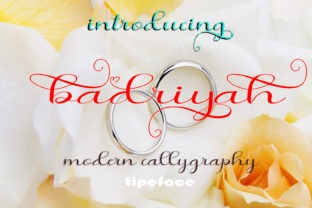
Badriyah is a true handwritten script font — not a brush script mimicking calligraphy, not a digitized signature, but a carefully observed, rhythmically uneven flow. Each letter has gentle pressure variation, subtle entry/exit strokes, and a slight forward lean that reads as quietly confident, not rushed. It’s warm, yes — but also grounded. There’s no forced flourish or over-the-top swash. Instead, you get natural alternates: two distinct ‘a’s, three ‘g’s, soft and sharp ‘t’ endings, and contextual ligatures that kick in smoothly when typing full words. It’s part of the Script Amp collection, which tells you right away this isn’t decorative fluff — it’s built for real design work.
Where Badriyah Shines (and Where It Steps Back)
In the tea project, Badriyah became the heartbeat of the identity — but only where it belonged. As a logo font, it worked beautifully at medium to large sizes: crisp on a matte-finish business card, legible on a 3-inch product label, and expressive in a website hero banner. Its organic spacing held up surprisingly well on screen, especially with modest tracking (+20–+40). But I quickly learned its limits: below 18pt, readability softened — fine for a tagline on a jar lid, but not for ingredient lists or legal disclaimers. And forget body text. This is a display font, first and foremost — best used for names, headlines, short quotes, and signature moments.
On packaging mockups, Badriyah added tactile warmth that digital sans serifs couldn’t replicate. Paired with a quiet, neutral sans serif like Inter or Manrope for supporting text, it created instant hierarchy and tonal balance — the handwritten voice, the clean framework. For social media graphics, it held up well in Instagram story headers and Pinterest quote cards, especially against soft textures or muted photography. But I avoided using it in dense carousel slides or long captions — it’s meant to be savored, not scanned.
Real Pairing Notes (No Guesswork)
I tested half a dozen pairings before landing on what felt honest and functional. Badriyah doesn’t shout for attention — so it pairs best with typefaces that listen. A low-contrast serif like Lora or Cormorant Garamond gives editorial weight without competing. A geometric sans like Space Grotesk or Clash Grotesk adds modern contrast while keeping the focus on Badriyah’s humanity. What *doesn’t* work? Overly tight, high-contrast scripts (they clash in rhythm), ultra-thin sans fonts (they disappear beside Badriyah’s gentle weight), or anything with aggressive terminals or sharp angles — it breaks the quiet confidence.
Also worth noting: Badriyah ships with OpenType features enabled — standard ligatures, stylistic alternates, and discretionary ligatures are all accessible in Illustrator, Figma, and modern web editors. No need to manually swap glyphs unless you want to. And yes — it includes basic Latin multilingual support (including accented characters for French, Spanish, German, and Scandinavian languages), which mattered when typesetting “Lavande” and “Rødbete” on seasonal blend labels.
A Few Practical Realities Before You Commit
If you’re evaluating Badriyah for client work — especially branding, packaging, or e-commerce — test early and test wide. Drop it into your actual layout files, not just font previews. Check how it renders at 16px on desktop and mobile (hint: use it sparingly there — maybe just the logo or H1). Print a few business cards and a label mockup — ink spread on uncoated stock can blur delicate connections, and Badriyah’s thin strokes hold up better than many scripts, but still benefit from slight stroke reinforcement in print-ready PDFs.
Licensing is non-negotiable. Badriyah is a commercial font from Script Amp, and its license covers desktop, web, app, and even limited merchandise use — but always verify the specific terms before embedding it in a Shopify theme, selling branded templates, or applying it to physical products like mugs or tote bags. When in doubt, go straight to the foundry’s license page. Skipping this step isn’t saving time — it’s inviting risk.
Who’s It Really For?
This isn’t a font for law firms, SaaS dashboards, or corporate annual reports. But if you’re designing for a ceramicist launching her first online shop, a neighborhood café rebranding with chalkboard menus and paper bags, a natural skincare line emphasizing hand-harvested ingredients, or a freelance writer building a personal brand that feels human-first — Badriyah fits like a well-worn apron. It brings sincerity without saccharine, craft without clutter, and personality without pretense.
Back on that brand board? I kept Badriyah. Not because it was trendy — but because it helped the tea brand say exactly what it meant to say: thoughtful, rooted, quietly joyful. And sometimes, that’s all a font needs to do.