Perfume: A Script Font That Breathes
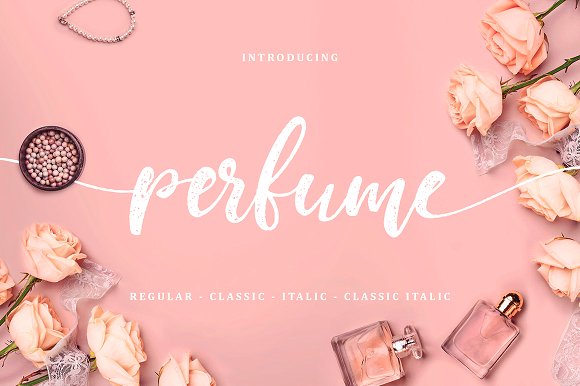
First glance at Perfume isn’t about sharp edges or tight kerning—it’s about breath. There’s a soft, unhurried rhythm in its lowercase ‘a’, a gentle lift in the ‘t’ crossbar, and a subtle taper in the terminals that feels less like ink on paper and more like vapor catching light. It’s not ornate, not fussy, not trying too hard. As a script font, it avoids the theatrical swirls of vintage calligraphy and the brittle precision of digital brush scripts. Instead, Perfume lands somewhere between quiet confidence and delicate intention—like handwriting you’d trust with a wedding invitation *or* a luxury candle label.
This isn’t a workhorse. It’s a presence. And presence matters most when you’re building brand identity—not just slapping type on a page, but shaping how people feel before they read a word.
Where Perfume Lives Best (and Where It Doesn’t)
Logo design? Yes—but only for brands that earn elegance without shouting. Think botanical skincare, small-batch perfumery, artisanal tea, or a boutique editorial studio. Its lowercase forms shine brightest here; uppercase letters are intentionally restrained, not dominant. Use them sparingly, if at all, unless you’re anchoring a monogram or pairing with a strong sans serif.
Packaging design is where Perfume earns its keep. On matte-finish glass vials, kraft boxes, or linen pouches, it reads as tactile and intentional—not screen-born. I’ve used it for product labels on soy wax candles and ceramic mugs: it holds up beautifully at 14–18pt when set with generous letter-spacing and ample margin breathing room. But don’t force it onto tiny ingredient tags. Below 10pt, the fine strokes begin to close up, especially on coated stock or low-res screens.
Social media graphics benefit from its mood—not its utility. A single-line quote over a soft-focus background? Perfect. A carousel slide packed with bullet points? No. Perfume is a display font, not a text font. It guides attention, then steps back. That makes it ideal for Instagram story headers, Pinterest quote pins, or limited-edition email banners—never for body copy, navigation menus, or accessibility-critical interfaces.
For printable design—wedding suites, art prints, recipe cards—it performs cleanly on both laser and inkjet printers, provided you embed the font properly. On Cricut projects, it cuts well at 1.25" height and above; smaller sizes risk fragile joins in letters like ‘e’ and ‘s’. Always test cut on scrap material first.
What Happens When You Actually Use It
Readability isn’t Perfume’s main job—but it *does* deliver clarity where it counts. At headline scale (36pt+), its open counters and consistent stroke contrast hold up across backgrounds: white, off-white, charcoal, even muted sage. It doesn’t compete with imagery; it complements. In editorial design, I’ve paired it with a warm serif font (think Tiempos Text) for pull quotes—creating hierarchy without visual noise.
Brand consistency stays intact because Perfume has a narrow but reliable personality. It won’t morph depending on context like some overly adaptive script fonts do. That predictability builds recognition. Customers begin to associate its gentle cadence with your voice—not just your logo, but your tone across packaging, web headers, and social posts.
That said, it does not project authority in the way a bold sans serif does. If your audience expects clinical precision (think medical tech or fintech), Perfume will feel misaligned—not wrong, just out of step. It thrives where warmth, craft, and human-scale detail matter more than speed or scale.
Pairing Is Everything—Here’s What Works
Script fonts live or die by their company. With Perfume, contrast is kinder than similarity.
- Serif font: A low-contrast, slightly rounded serif (e.g., Lora or Cormorant Garamond) grounds its fluidity without stiffening it.
- Sans serif font: Go warm and neutral—Poppins Light, Sofia Pro Regular—not geometric or ultra-thin. Avoid anything with sharp corners; they clash with Perfume’s organic flow.
- Handwritten font: Skip it. Two scripts in one layout dilute focus. Perfume already carries that hand-drawn authenticity.
- Display font: Only if it’s minimalist and structural—think a clean, single-weight grotesque used strictly for subheads or captions.
I avoid pairing Perfume with other script fonts—even from the same foundry like Script Amp. Their rhythms fight. One expressive voice is enough.
Designer Notes You’ll Actually Use
Before locking in Perfume for client work or your own digital product:
- Test it in black and white—no color tricks hiding weak contrast or uneven spacing.
- Check small-size readability on real mockups: print a 12pt sample on your intended paper stock, or view it at 100% on a mobile screen.
- Compare uppercase vs. lowercase usage side-by-side. Its lowercase has more character—and more versatility.
- Review default spacing. Kerning pairs like “To”, “Va”, and “Ye” often need manual adjustment for even rhythm.
- Confirm commercial licensing. Perfume is a premium font—you’ll need an extended license for digital products, Canva templates, or resale assets like printable planners.
And one more thing: don’t treat it like decoration. Perfume works best when it serves meaning—not just mood. A handwritten “thank you” on a subscription box feels personal. The same phrase repeated across ten social ads starts to feel like wallpaper. Use it with restraint. Let it breathe.
A Final Word on Trust
Typography builds trust quietly. When Perfume appears on a product label, it signals care in execution—not just aesthetics, but intention. That matters to customers who choose small-batch over mass-produced, who read ingredient lists, who notice stitch quality. It tells them: *this was made by someone who pays attention to the small things.*
That’s why Perfume isn’t just another script font. It’s a tool for designers who understand that type isn’t decoration—it’s dialogue. And sometimes, the softest voice carries the farthest.